

Eight years before Minnesota statehood, Minnesota Territory was included in the United State census of 1850. A year previous, the Minnesota Territorial assembly had created nine counties. What is now Houston County was then part of a very large Wabasha County, which extended from the Mississippi River west to the Missouri River (now in central South Dakota) and from the Iowa border north to the mouth of the Minnesota River (near St. Paul). Houston County, as well as Fillmore County, was created on February 23, 1854.
It was entirely Indian land except a small portion in what is now southern Houston County and southeastern Fillmore County. The Winnebagos had been removed in 1846. It had not yet been surveyed or opened to settlement. But along the Mississippi River, there were a few settlements, trading posts and Indian missions.
The census of 1850 Wabasha County enumerated 243 people, including women and children. Along the river, there were 14 farmers, 10 laborers, six carpenters, five voyagers, four traders, three blacksmiths, two raftsmen, two lumbermen and one missionary.
Fur trading had become less prominent, but there still were voyagers and Indian blacksmiths. Voyagers were boatmen employed to transport furs to the markets further downstream on the Mississippi River. The government designated Indian blacksmiths to repair the traps and guns used by the Indians.
Those census records did not always specify women and children, but four married families lived in what is now Houston County. Exact locations of all residents cannot be verified, but there were thought to be at least three settlements in what became Houston County.
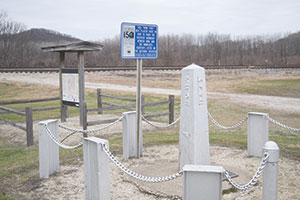
Photo by Lee Epps
One early history of Houston County identified two Pennsylvania brothers, Samuel and John Ross, who in 1847 came up from Galena, Ill., to what is now Jefferson Township in the far southeastern corner of the county. They were not listed in the 1850 census, possibly because they were so close to the Iowa border that they were missed or overlooked. An 1852 survey showed one Ross claim was completely in Iowa and another was divided by the state line.
The line between Minnesota and Iowa had been determined on August 4, 1846 (year of Iowa statehood). After much contention, Congress finally adopted the latitude of 43 degrees and 30 minutes. Several years elapsed before an official marker was placed in the settlement of Ross’ Landing – now New Albin, Iowa. A six-foot-high, cast-iron obelisk, inscribed with the year 1849, still sits about three miles from the Mississippi River along highway 26 just north of New Albin.
One pre-1850 river settlement in what became Houston County was Brownsville, located about 11 miles north of Ross’ Landing. During territorial days, it was the most prominent town in southeastern Minnesota. It was named for its founder, Jobe Brown, an adventurer from Michigan, who had worked in the lead mines of Galena, Ill., and served in the Mexican War before coming to Minnesota Territory in 1848/49. Coming downriver from La Crosse, Wis., Brown encountered some trappers at the mouth of the Root River before continuing south to settle below what became known as Wild Cat Bluff.
By 1850, he had been joined by his brother Charles and river rambler Jack “Wild Cat” Jackson. The latter planned to shoot Brown before being shot himself in a brawl with his own gun.
Of the 14 men in the 1850 census identified as farmers in what became Houston County, Jobe Brown was the only one designated as actually owning a farm. Owner of 160 acres, Brown had cultivated four acres and possessed a team of horses valued at $60. This is the earliest mention of agriculture in the history of the county.
The census identifies lumbermen William Richmond and William Frink, who harvested walnut timber and rafted it down the Mississippi. Each was married with a family. Farther up the valley lived the family of German-born John Kripp, who was engaged in the same lumbering and river-rafting occupation.
There were other settlers along the Root River Valley by 1850. One tale persisted about the first settlers who arrived at what became the townsite of Rushford finding a burial site with a primitive cross, inscribed with the date 1849.
This information came from area historian Percival Narveson as published in his book, Percival Narveson’s Historical Sketches.