

Photo by Wanda Hanson
On June 30 a small group gathered at the Rushford Depot ready to check out the progress at the building. The Rushford Area Historical Society (RAHS) had received a Legacy Amendment large grant totalling $254,953 from the Minnesota Historical Society in January 2024. The money was requested to stabilize the foundation of the depot as well as improve the visitors’ center and the roof of the depot. Now approximately half of the grant money has been spent. Typically, an inspection is done at that point. Construction work on the project began in early fall. After a pause to clarify some requirements, work resumed.
Both Design Reviewer John Beaty and State History Services Manager Todd Mahon from the Minnesota Historical Society were on hand to see the progress thus far. Also in attendance were architect Todd Grover, FAIA (Fellow of American Institute of Architects) from MacDonald & Mack Architects, Cody Johnson, owner of Norse Valley Construction, and Ryan Benson, project foreman of Norse Construction. Representing RAHS were Terri Benson, Nancy Snyder and Sally Ryman.
Before entering the depot, Todd Grover explained the specifics of the issues with the foundation. The sill beams of the depot were rotting in place on grade; they had simply been laid on the ground when the building was built. When the renovation began, the second floor of the building was “rocking and rolling”, to quote Grover.
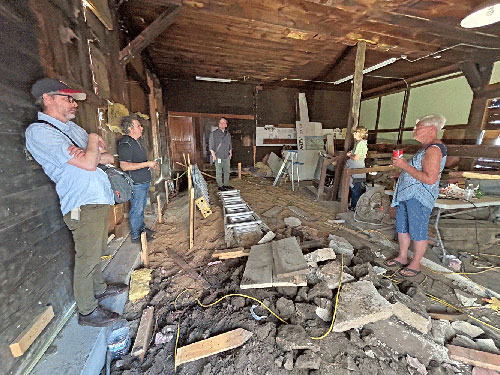 When the construction crew cut open the protecting plastic, everyone could see there was still a lot of work to be completed.
There were two options to choose from to stabilize the foundation. One option was to lift the entire building. The other more “sympathetic” option was to hold the building in place with helical piles. The helical piles look like big metal corkscrews; they come in lengths of five or 10 feet. A total of 14 helical piles, each 25- to 30- feet deep, needed to be placed in the ground. Beams were then needed to be installed to connect the piles and support the depot. A benefit of using helical piles is that the grade could be dug out and the building would continue to float on the piles and beams. Since the depot has no basement, this was a good option for the project.
As the work progressed, the construction company also tried to correct the north wall of the depot. Over time, that wall had become concave all the way up the wall with the bottom bowing out. The wall is stable at this point, but not perfectly straight. It had begun sagging after renovation work had been done in 1985 at the depot. During the flood of 2007, it had “shifted heavily.” The rotting sill beam no longer provided near enough support for the depot.
The bottom of wooden columns in the baggage area were rotten as well. Portions of the columns needed to be replaced with concrete.
The baggage room of the depot which was used for a visitors’ center was on grade; the waiting room for the depot was built higher as was the custom. During the 1985 renovations, the wooden floor in the baggage area had been directly covered with a layer of concrete. Another layer of concrete had been added later when the baggage area was used for storage by Tri-County Oil and Tri-County Electric.

Photo by Wanda Hanson
Once the final grade beam on the south side of the depot is poured, work will begin on the baggage area floor.
Both old layers of concrete and the underlying wood will be removed in the area. After a gravel base is added, a new concrete floor will be poured in that area. ADA bathrooms will be installed in the south side of the baggage room. A storage area mostly for artifacts will be created as well as a small area for utilities. The wooden floor in the waiting area of the depot didn’t see as much rot since it was elevated.
Todd Mahon of MNHS commented, “This is a really cool project! Being able to see the building all opened up is really great! From ground disturbance and historical perspective, this is a great way to do it!”
According to Sally Ryman, RAHS will be applying for a windows grant this fall for the waiting area and upstairs rooms.
Expectations are that the project will meet the grant schedule easily. Beams will be done in mid-July and work will progress quickly after that. Original painted boards from the depot have been found. A section of those boards will be displayed in the renovated depot to show its original color.
The renovated depot will not be just like new. Architect Todd Grover quoted Bob Mack, the founding principal of MacDonald & Mack, when he declared, “Wrinkles show character!” The Rushford Depot will still have a few wrinkles; but it will be a treasured historical building in Rushford filled with local artifacts. MNHS has promised to help create a presentation in the renovated space to enhance Rushford’s collection once construction is completed.