

Norwegian emigration, part 6
Many of the Norwegian immigrants, which would settle in Houston and Fillmore Counties as early as 1851, had their ocean voyage end at the port cities of Quebec or New York. Then after another voyage across the Great Lakes and/or a train ride or two, they reached Chicago or Milwaukee.
Some, like the families of Thore Elemoen in 1853 and Knud Rauk in 1859, would then come directly to Houston County. But many resided in established Norwegian settlements in either Wisconsin or Illinois before heading west again as evidenced by two Wilmington Township families. After immigrating in 1853, Christian and Anne Glaeserud remained a year in Racine, Wisc. The Endre Tryhus family resided in Koshkonong, Wisc., and Davis, Ill., for six years before son Thomas homesteaded in Wilmington about 1854.
For a period of five years, everyone was headed for the Fox River colony in northern Illinois, which in 1834 became the first permanent Norwegian settlement in America. Dating back to 1837, those originally headed for Fox River were recruited to settle farther north in Muskego, Wis. – about 15 miles southwest of Milwaukee. Immigrating in 1840, Hans Hansen Bakke farmed near Muskego for 15 years before relocating west of Spring Grove.
Near Lake Muskego, the marshes alternated between dry and flooded; clearing the forest was the only alternative. Other challenges included killing four or five rattlesnakes a day plus removing toads and worms from drinking water. Muskego and Fox River were ravaged by disease between 1849 and 1852. Malaria – with burning fever alternating with trembling chills – was widespread and tortuous but not fatal; however, cholera was a killer. Starting in 1849, there was not time for funerals, since someone died almost every day. Thousands of young and old perished in these two older settlements. Poverty intensified the misery and prevented many panic-stricken pioneers from moving on.
Farther west, the settlements of Rock Prairie, northwest of Beloit, and Koshkonong, near Madison, would become the two most important entry and stopover centers for Norwegian immigrants who would eventually settle in Iowa and Minnesota. The Ole Sagadalen family spent a few years at Rock Prairie until joining an 1853 oxen-drawn, immigrant caravan to Spring Grove.
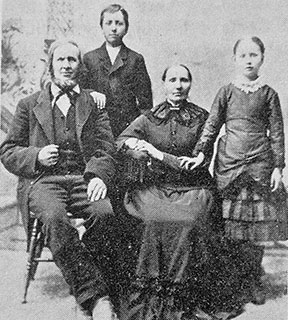
Photo submitted
Unlike Muskego, Koshkonong had all the physical features for pioneer success – water, wood and fertile farming land. Settled in 1840 near Lake Koshkonong by immigrants from Fox River, Koshkonong prospered and thrived in the 1840s and 1850s.
Toward the end of the 1840s, most of the good land near the older settlements had been taken. And also, in the true pioneer spirit, some Norwegian landowners, sold their farmland at a profit and bought less expensive land on the frontier.
Rasmus Spande, one of the first to arrive on Stavanger Prairie in Preble Township, Fillmore County, in 1854, said “I… came to Fox River settlement in company with neighbors from our community in Norway. Land around Fox River was already too dear to buy, and it was hard even to find work. There was at this time considerable talk about Iowa, but as some of my neighbors had gone to Minnesota the year before; I decided to follow. Where this place Minnesota was or whether it was as large as a church parish or a continent, I had no idea. But we started off and were kept looking from railroad to ferry and from ferry to steamboat.”
The expansion of railroads was a major impetus for westward migration. Train travel was much quicker than walking beside an oxcart, and trains could transport farm produce to population centers back east. And railroads, like the government, had land to offer newcomers. By 1854, railroads connected Milwaukee and Madison and then reached the Mississippi River at Prairie du Chien in 1857.
Once reaching the Mississippi River, immigrants could take a steamboat as far as Brownsville or even St. Paul. At small Wisconsin commercial centers along the Mississippi, they could arrange to ferry across the river and continue on ox-drawn wagons or on foot. Margit Engen, at age six months in 1857, was brought by her parents by train to Prairie du Chien and then by boat to Brownsville where the family then walked toward Spring Grove.