

You did not phone a serviceman or purchase a new replacement part “if you had a kid big enough to hold a screwdriver,” – not during the Great Depression of the 1930s, according to Anita Joyce (Hartman) Palmquist. She was a farm kid in Pleasant Valley near Hokah, who unenthusiastically did hold a screwdriver while her father Carl Frederick Hartman turned the crank of a large engine as dry cell batteries in a wooden box supplied the spark. “I was deathly afraid of that big old engine,” recalled Palmquist. “After a few cranks, the monster sputtered and chugged and took off clanking and vibrating. I didn’t want to be anywhere near. As the engine aged, its governor went wild. One of us had to stand and hold a screwdriver against a certain part to keep it running right while it pumped the day’s water supply.”
That gas engine pumped water or turned the cream separator or the washing machine. A long belt could be attached to saw wood. Palmquist said her father had to be around to turn the crank every Monday morning, which was washday.
“There was no question how the women of my childhood spent Monday,” recalled Palmquist. Her mother Hazel Belle (Schild) Hartman had a wooden washing machine, turned by that old gas engine, in an extension to the milk house. “Eventually, the washing machine must have worn out; we soon were scrubbing clothes by hand.”
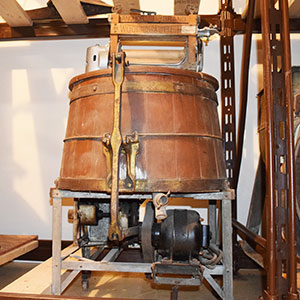
Photo by Lee Epps, courtesy of the Houston County Historical Society
During the summer, the washtubs and washboards would be outside. In winter, clothes were washed in the kitchen. Rainwater from the cistern was pumped by hand and carried into the kitchen to be heated in the wash boiler, a cast iron or copper cauldron in which clothes or soapy water could be heated over a wood-burning stove. The water was then dipped out again and poured into the tubs, which had an attached hand-cranked wringer.
Lump starch was soaked in water and brought to a boil. Starch was used for house dresses, aprons, dresser scarves and cotton blouses as well as the collar fronts and cuffs of men’s shirts.
“Rubbing sheets and overalls on a washboard was backbreaking work,” added Palmquist. “Hand-cranked wringers never got the clothes very dry,” which made them heavy while being carried outside to the clothesline.
“Good housekeepers had to hang clothes outdoors in the winter,” she added. “There was pride in freezing your clothes dry. Hanging wet clothes out in zero-degree weather was pure misery.” And even then, clothes were not completely dry when brought back indoors for the night. “They smelled wonderfully fresh as we draped them around the house to finish drying. We had a reel clothesline that could be unrolled and stretched kitty-corner across the kitchen. Until they were dry, we ducked under them each time we crossed the kitchen.”
Hand towels received special attention, since they became very soiled by hand wiping after handling pots and pans that were covered with soot from the wood stoves. After being washed, the hand towels were then boiled in soapy water in the wash boiler. “They were fished out with a wooden stick and rinsed. By the time evening came, the kitchen was a mess.” However, warm soapy water was too useful to waste. Some was used to clean the floors of the kitchen, the milk house and the porch as well as cleaning the sidewalks and the outhouse.
Maytag washing machines revolutionized washday. A salesman made a house call to demonstrate the machine, which was powered by a gas engine. “The salesman did the family washing,” vividly recalled Palmquist. “My parents were convinced. They purchased the wonderful machine. Our washings were huge. There was always bedding for four beds. Five women needed 30 dresses and several aprons per week. The new machine was a great labor saver. By the time I was 12 (in 1934) and in the eighth grade, I could do the washing alone. I felt it was a real treat if I did not have to do field work and could stay in to wash clothes.” But care had to be taken. If the fabrics were not properly sorted, dark colors faded. “If a red sock got in with white clothes, the clothes stayed pink forever.”
Anita Joyce (Hartman) Palmquist, with the help of her niece Judy Lee Wothke, published these memories in a book, My Story: Memories and Writings.