

With the completion of the transcontinental railroad in 1869, transcontinental stagecoach traffic ended. The arrival of railroads in southeast Minnesota in the 1860s and ‘70s signaled the demise of stagecoach passenger service. By 1880, most of Minnesota was accessible by railroad. And it would not be long before automobiles replaced stagecoaches in the delivery of mail.
In Houston County, there had been more than one stage line servicing the booming burg of Riceford – until 1879, when the railroad bypassed that narrow valley in favor of wider open spaces, such as Mabel and Spring Grove. Some Riceford shops and homes were dismantled onto hayracks and moved to Mabel. Meanwhile, Houston, situated in a wider valley on the banks of a navigable river, did receive rail traffic.
Throughout the middle of the nation, the location of railroad tracks often determined which pioneer villages would flourish and which would wither. As stagecoaches had previously attracted shops, hotels and services, so did the railroads.
But like oxen and wagons, trains could not reach the prairies without crossing rivers, most pertinent to southeastern Minnesota – the mighty Mississippi. And like horse-drawn vehicles, they had to first rely on watercraft. Rivers, especially the Ohio and the Mississippi, had transported settlers to the western frontier. The large rivers that bore the most traffic also presented the greatest obstacles to cross. Railroads came to southeast Minnesota before there was a suitable bridge across the Mississippi.
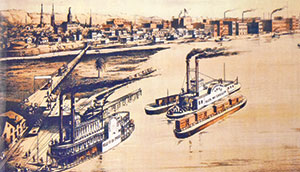
Photo courtesy of Houston County Historical Society
The Minnesota Territorial Legislature had provided land and financing for rail from La Crescent up the Root River Valley. By the autumn of 1866, there was track from just east of Hokah to within a mile of Houston. A year later, the tracks had reached Rushford – two years later, Lanesboro. By 1870, it was on to South Dakota.
But there was no rail connection across the Mississippi River to La Crosse, which was eager to access the agricultural prosperity of southern Minnesota.
In those early years, the cargo was transferred to barges and ferried across the river. Then the railcars were loaded onto barges as well. In the winter, a bridge was built on the ice. The terminus on the west bank of the Mississippi was known as Grand Crossing, north of Target Lake and just below the southern tip of Barron Island.
Finally, in 1876, a permanent bridge was completed and a formidable obstacle had been overcome. The resulting passenger service replaced stagecoach passenger runs on the Territorial Road from Houston County to St. Paul.
But stagecoaches carried more than travelers and light cargo; the U.S. Mail contracts guaranteed success. However, the development of electric and gasoline-powered automobiles and motorcycles provided a speedier alternative during the earliest decade of the 20th century. This was especially the case when the Postal Department began direct delivery to every home – adding rural service to already established urban home delivery.
Free mail delivery had begun in American cities as early as 1863, during the Civil War. However, remote, rural residents had to pick up their mail at sometimes distant post offices or pay private carriers. Before radio, a newspaper in the mail was a vital connection for farm families in an agrarian society.
Free mail delivery directly to American farms began experimentally in 1896. It would become the largest and most expensive U.S. postal program to date and took several years to implement. By 1902, there were 331 rural routes in Minnesota. The Caledonia post office was the first in this part of the state to initiate the service. By September 1905, there were 17 rural routes in Houston County – five from Houston, five out of Spring Grove and four from Caledonia. With more on the way, the Winona Republican-Herald predicted complete county coverage in the near future.
Horse-drawn delivery became even less practical in 1913 when parcel post provided for the mailing of packages weighing up to 50 pounds.
While the stagecoach business boomed for only about 30 years in Minnesota, it played an essential but often overlooked role in the state’s early settlement, development and prosperity. A section of the Red River Valley stage route was listed on the National Register of Historic Places in 1991.