
 Presidents, founding fathers and especially military heroes were memorialized in Houston County with village namesakes, such as Hamilton, Jefferson, Reno, Houston, Winfield and San Jacinto. Only Houston, Reno, and with a name change, Hamilton survived.
Although Mexican War heroes figured most prominently when choosing village names, two founding fathers were also remembered. Area historian Percival Narveson wrote Jefferson was named for President Thomas Jefferson and Hamilton for Alexander Hamilton, first Secretary of Treasury.
The town of Hamilton in Houston County was not the first Minnesota town so named, therefore the post office had to have a different name. Hamilton became Money Creek.
In Jefferson Township, the village of Jefferson was first known as Ross’ Landing and then New Landing. In the far southeastern corner of Minnesota, Jefferson thrived around the Jefferson Grain Warehouse, built in 1868 on a landing site accessible by Mississippi River steamboats. The state’s only surviving riverside grain warehouse is listed on the National Register of Historic Places. The limestone and wood building still stands about a mile north of New Albin, Iowa. Jefferson was doomed when the river changed course, the railroad preferred platting New Albin in 1871 and the remaining buildings were demolished in 1940 to make way for Highway 26.
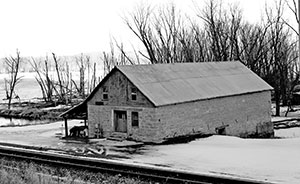
Photo by Lee Epps
Both a village and the county were also named for a president – the president of Texas, Sam Houston, later a U.S. senator. He was not as much honored for his presidency as for his military leadership during the Mexican War as well as the Texas Revolution.
Houston and General Winfield Scott were national heroes of the Mexican War (1846-1848), which was a recent memory for early Minnesota settlers in the 1850s, especially the veterans who came to southeast Minnesota soon after the war.
Mexican War veteran William G. McSpadden, who had served under Houston, named the village of Houston before veteran Captain Samuel McPhail proposed the name of the county to the territorial legislature.
Numerous villages were platted and named by land speculators when it became evident that many 1850s settlers would be moving into Minnesota Territory. McSpadden relocated from Wisconsin and platted two neighboring villages in the Root River Valley, including Houston on the south side of the river in 1852. North of the Root near Silver Creek, by 1855, he was platting the village of Winfield, named for Gen. Winfield Scott. About the same time, two rival villages, St. Lawrence and Looneyville, were platted nearby. John S. Looney was the first permanent white settler in what became Looney Valley.
The railroad came south of the river through Houston in 1866-67 and crushed any lingering hopes north of the river. An 1857 postal map included Houston, Winfield and Looneyville – but not St. Lawrence, where only a Catholic cemetery now remains. A county history said “two potential cities never became more than “paper” towns. Looneyville did have a store for a short time, but St. Lawrence never was more than a sale of lots between land promoters.”
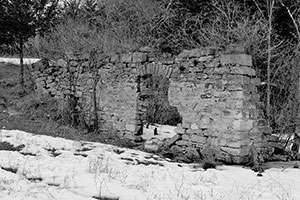
Photo by Lee Epps
The postal map also shows the village of San Jacinto (east of Houston and northwest of Hokah), which surely also honored Sam Houston, whose victory at the Battle of San Jacinto ended the Texas Revolution.
Area historian Mason Witt wrote of Winfield, “Mac” (McSpadden) built a large hotel, but it was destined to serve as a farmhouse until it burned in 1960… He also built a blacksmith shop and planned other buildings. For a short time, Henry Wilson ran a saloon in Winfield.
“McSpadden started a dam in the sandstone gorge in 1855… He installed a sawmill… Most of the early construction, in the Houston area, came from this mill. By the end of 1856, Mr. Wilson had left, and it was apparent that Winfield was not going to attract any significant settlement, and so died Mr. McSpadden’s dream.”
McSpadden’s farm was long known as Winfield Farm. A current house was built on the foundation of his burned farmhouse. A portion of the basement of the sawmill, later a gristmill, still stands in deteriorating condition along Silver Creek. The dam also survives.
Another Mexican War officer, Jesse Lee Reno, was the namesake for the Mississippi River village of Reno, which became a busy transfer site for railroad shipping.
Lee Epps earned bachelor’s and master’s degrees in history before teaching high school history.