
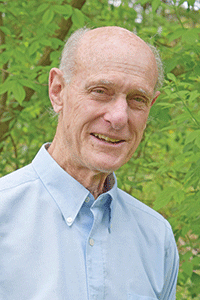
 “In those days, the kids went barefoot, so occasionally, we’d step on a nail,” recalled Ray Fruechte about his early 1900s boyhood in rural Portland Prairie, northwest of Eitzen. “… we would take a foot pan, put a little water in it with carbolic acid in the water, mix it up and then soak our foot in that. Later on, we used iodine and mercuricomb (mercurochrome), followed by the wonder drugs sulpha (sulfa) and penicillin.
Fruechte pointed out there were “local wonder drugs” available in Houston County, even a few years before his birth. In 1904, the area celebrated the 50th anniversary of the 1854 founding of Houston County. The businessmen of Caledonia published a booklet about the history of Houston County, which also contained ads for their local businesses. The Belden-Fullerton-Rhines Medical Company was a Caledonia manufacturing enterprise owned and operated by registered pharmacist W. D. Belden, veterinarian I. F. Fullerton and medical doctor D. C. Rhines.
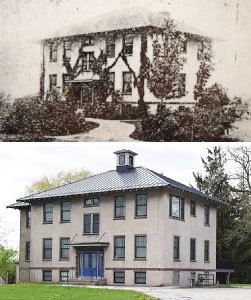
Top photo courtesy of Don Ellestad Bottom photo by Lee Epps
One ad stated, “A great success – Dr. I. F. Fullerton’s Heave Electuary. Nothing made or sold like it. It is a specialty of Dr. Fullerton’s which he has used with wonderful success in his practice. When directions are followed, it affords quick relief and will cure all curable diseases.” Fruechte assumed that the veterinarian’s wonder drug was used only to treat animals.
Dr. Rhines also had an ad in this booklet. “Popular remedies manufactured in Houston County, originated by and prescribed by Dr. D. C. Rhines. Old folks tonic. The greatest of all tonics and restoratives for invalids and old people. Imparts new life and vigor.” Fruechte commented, “I wish at (age) 89, that this would be available today.”
That same Dr. Rhines had come to the Fruechte family farm from Caledonia in a horse-drawn sled for Ray’s 1911 birth on what the weather bureau called the “coldest January 3 on record.” Another Dr. Rhines episode came when little Ray, with a recurring hacking cough, was taken to the doctor’s office. “Dr. Rhines told me to open my mouth and say “ah,” and he looked into the back of my mouth. “Well,” he said, “I don’t think it’s anything very serious, but if that cough persists, bring him in again, and maybe we’ll have to do a little surgery on him.” Fruechte claimed Dr. Rhines must have been a “very good doctor, because the threat of surgery” cured his cough.
During Fruechte’s childhood summers, around 1920, there were traveling “medicine shows,” which came to Eitzen, charging about 10 cents to enter a large tent to watch a silent movie, usually a western. “That was just down our alley,” noted Fruechte. But there were live, pre-show commercials when a barker would tout the amazing benefits of near-miraculous medicines. One year, he recalled a medicine called “Cooling,” which sold for a buck a bottle. “That was supposed to cure just about everything; make you feel better at least.”
The same crew also offered healing oil that was 35 cents a bottle. “The fellow would take the insole of a shoe, pour some healing oil on the insole, and before long you could see the bottom becoming wet. He’d say, “that’s just what happens. This healing oil soaks through the skin, goes into your muscle and relieves the pain.”
Fruechte had a serious medical emergency, just before his 18th birthday. Home on Christmas break while a student at the School of Agriculture in St. Paul, he had an attack of appendicitis and was put in the Caledonia hospital for surgery.
“They put me in the operating room, gave me “laughing gas,” which made me kind of silly. Then they gave me ether, and that put me out. When I woke up, I had an awful cough, which hurt. I suppose it was the ether in the lungs that made me cough. At that time, they kept people who had an appendectomy in the hospital for about two weeks. I spent Christmas, New Year’s and my birthday in the hospital.”
About 11 o’clock, on New Year’s Eve, a nurse – in a celebratory mood – took a bottle of beer out of a private refrigerator. “That was how we spent the first minutes of 1930!”
This column is based on personal recollections of 89-year-old Ray Fruechte (1911-2003) published in 2001 in Caledonia Pride.