
 Part two of a series
They were all “so hard up,” the young folks in the Eitzen area had to manufacture their own fun, recalled life-long Portland Prairie resident Elmer Thies about the Great Depression era of the late 1920s and 1930s. Entertainment involved roller skating parties, shadow pie sales, county fair booths, parade units and shivarees (a noisy, post-wedding serenade of the newlyweds).
“There were quite a few young people on the prairie in those days,” remembered his neighbor Ray Fruechte. “We didn’t have any problem entertaining ourselves. We hung May baskets. Well, I guess we hung May baskets all summer as far as that goes.”
A May basket was a May Day (May 1) tradition when baskets of picked flowers, candies, etc. were left anonymously on the front doorknobs of friends, neighbors, loved ones or someone of romantic interest. The feat involved hanging the basket, knocking on the door and escaping on foot before the knock was answered.
Way before May, on a snowy winter evening, an impromptu group of young skiers decided they needed a toboggan for an icy snow cover. “We had a piece of corrugated tin left over… from roofing the barn,” recalled Fruechte. “A bunch of us took that down in our basement and made a frame of 2x4s, nailed the tin to the bottom of the 2x4s, turned up the front end and made a brace to keep the front end up.” That toboggan accommodated six or seven riders.
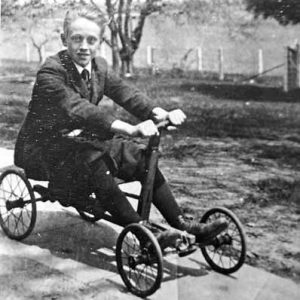
Photo courtesy of Ray’s daughter, Mary Amundson
“We had a real steep hill … and it was a little bit icy, and boy did that thing ever travel… One time the toboggan was headed for a stump, and Frank McNally stuck his foot out to change the course of the toboggan. Too bad, Frank sprained his ankle … walked around on a sprained ankle for a couple of weeks.”
Summer months brought out-of-town entertainment when medicine shows arrived. They made money by hawking medicine plus a 10-cent admission to the entertainment tent, which usually featured a silent western movie. One year, Ray had an unexpected moment of fame when just before the movie, a fellow called for all the boys aged of 10 to 12 to come up on stage. Ray qualified. Then the fellow said, “I want you boys to take off your shoes and throw them in this big box.” After the shoes were deposited and stirred up, he said, “Now go and find your own shoes and lace them up. Then first one that gets through will get a prize.” Ray was the first re-shod, laced up and standing. “The fellow… put one hand on my stomach and the other on the back of my neck! I didn’t know what was going on!” Then young Ray figured out he was supposed to take a bow, and so he did. The fellow then said, “I wish to present to this audience the shoe-lacing champion of Eitzen.” He then awarded Ray a quarter.
During the ensuing western movie, the hero embraced his girlfriend, and Ray recalled a “big fat fellow” in the audience getting up and saying in German, “Now hang onto him.”
Fruechte said Lola Dibley organized (about 1931) a “hometown play on the prairie.” In Eitzen Hall, they performed “Back to the Farm,” which he said was nothing too terrific but enjoyable enough that they put on a couple of plays the next year. One production, “Beads on a String,” called for someone to take a double part – one as a boy and then another as a girl.
“I happened to get that part,” said Fruechte, “and I had to talk like a girl. I had Emma Deters’ shoes; they fit me pretty well. I had long stockings. The skirts weren’t very short then, so not much of the stocking showed, and it looked like a girl. At one time, I had to change clothes from a boy to a girl in just a few minutes. I sat down on a chair; two people took my boy shoes off and put Emma’s shoes on, put Mrs. Barney Sholes’ velvet dress over the top of my head and put a blonde wig over my head. And on I went.”
This column is based on previously published recollections of then 89-year-old Ray Fruechte (1911-2003).