
Fifth of a series
Portland Prairie had the first 4-H club in Houston County, organized in 1923 by Gladys Lapham, said one of the charter members, Elmer Thies. His 4-H project that first year was a heifer calf named Nancy. At the county fair, young Elmer and Nancy won a trip to the state fair, but as it turned out, young Elmer was too young. “I was only nine years-old. One needed to be 10 years-old. Reckon I was too young to be really disappointed.”
The Great Depression of the 1930s, may have had something to do with organizing the Houston County Rural Youth Group, according to Thies, the first president and one of the founders. Thies said money was so scarce that rural youth had to “manufacture” their own entertainment, such as roller skating parties, county fair booths and parade units. They would make May baskets and June baskets and deliver them to neighbors. There were free movies in Eitzen, dances, community bands and concerts. “In Portland Prairie, too, we put on a number of home-talent plays in what was then the Eitzen Hall,” said Thies. “Admission was usually 25 cents, and even that was hard to come by!“
Between 1929 and 1932, United States farmers’ purchasing power was reduced by 50%. One-fourth of the nation’s workforce experienced unemployment. The Civilian Conservation Corps (CCC), a federal agency, employed 250,000 previously unemployed men to work on reforestation, road and bridge construction and flood control. One of the CCC camps in Houston County was at the fairgrounds in Caledonia in the late 1930s.
However, Thies said most of his family and friends worked on farms, some for a dollar a day plus room and board. Too young to recall the farm prices in the 1920s, Thies knew how depressed were the prices in the 1930s when butterfat in milk was about 28 cents a pound and hogs around $2.00 a hundred pounds. Houston County farms produced all they ate while purchasing only sugar and flour.

Thousands of the nation’s banks failed during the 1930s, and there was not yet deposit insurance. Life savings were lost. However, the bank in Eitzen survived and encouraged farmers to keep working. Because farming in Houston County continued, Thies said some people moved in from the drought-devastated southern plains, known as the Dust Bowl.
Life was difficult and could be brief. Two of his six siblings died as children from polio and appendicitis. Diphtheria and typhoid fever were other threats. Elmer, at age 10, had an appendectomy in Caledonia. His father died in 1939, likely Thies surmised, due to the economic stress of the Great Depression.
Farming was hard work for human and horse, especially before tractors (for those who could afford them) came into use in the mid-1930s. “It was either two horses hitched to a single-bottom walking plow, then the single-sulky riding plow,” said Thies. “From there to the two-bottom, gang plow pulled by four or five horses. I often think of how hard those horses had to work, day after day, pulling heavy loads in the field and on the roads. In the heat of summer, the horses needed to pull the grain binders, which cut the grain, tied it in bundles, which then needed to be shocked by hand, then hauled in to the threshing machine to separate the grain from the straw. Sometimes, the threshing machine also used horsepower. Almost makes me tired thinking of all the hard labor that went into farming.”
The mechanical corn picker was a new invention. Previously, corn was husked by hand. A horse-drawn wagon contained a wagon box that held 25 to 30 bushels of corn. There was a three-foot-high “bang board” fastened to one side of the wagon box to stop the ears as they were husked and thrown one by one by the human husker. A really quick cornhusker could pick about 100 bushels a day – “really long day,” Thies noted.
But proficiency could bring reward and recognition. There were county, state and national cornhusking competitions – “Indeed an honor and an accomplishment,” said Thies. “They would wear a husking hook or peg on one hand and make those ears fly at an almost unbelievable fast clip.”
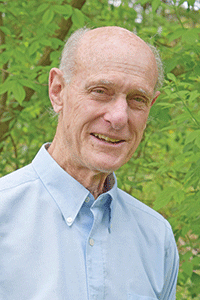
This is the fifth column based on previously published recollections of the 1920s and 1930s, the last two of great storyteller Elmer Thies (1914-2019) with appreciation for the school project of Mike Wray.