
 Part two of a series
Can you imagine sharing a telephone line with 20 families – not 20 people, but 20 large farm families. No? Well, it was better if one lived in town.
Telephones (most likely diaphragm string phones) had come to southeast Minnesota in the 1880s with “electric speaking” phones available in the mid-1890s. The first switchboard came to Caledonia in 1900. Cities and towns were the first to have telephone service, but most people did not live in town. Even three decades later, a 1933 newspaper reported the telephone company in Caledonia served 525 rural subscribers and 240 city residences.
After Bell Telephone Company’s patents expired between 1893 and 1896, hundreds of independent telephone companies were organized, and unlike Ma Bell, rushed to tap the small town and rural market. Houston County was no exception. Some “farmers’ lines” were cooperatives organized by subscribers, who each owned one share of stock.
An 1892 Spring Grove newspaper reported that Jeweler Ellestad, while extending his telephone operations into farming communities, was constructing a line into Wilmington.
In 1902, the Houston County Chief noted, “Farmers’ telephone lines, running from Hokah through Union to Caledonia and south over the ridge to Brownsville are promised in the near future. Soliciting among the farmers… has met with ready and promising response…”
However, there was some hesitation. Lifelong Portland Prairie (near Eitzen) resident Ray Fruechte told about a farmer asking a man working on a telephone line, if he bought one of these telephones, would he be able to “talk German” on it. The reply was, “Oh no, that would twist the wire right off.”
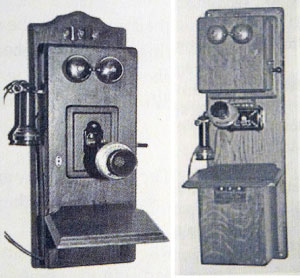
Photo and drawings courtesy of Houston County Historical Society
Farmers lines had limited calling range, due to weak battery strength in individual phones as well as the patchwork line construction. There were some reliable iron wires strung on poles along roads and buggy paths. But during the 1890s rush to serve farmers, there might be barbed wire phone lines following fence rows and baling wire lines strung through pastures or woods. Trees were as useful as poles.
Battery power transmitted the voice. On farmers’ lines, one could call into a rural community telephone with greater battery power to put through a long distance call. If this system was unsatisfactory, farmers could always, albeit less conveniently, place a long distance call at the community phone in town.
Early telephone lines were highly susceptible to lightning, which was even known to cause death if a phone was not properly grounded. All phone companies recommended cleaning the lightning arrester on the old wood phones after electrical storms, which could cause carbon buildup. It was discovered by accident that “pigtailing” phone lines not only made them more attractive but also less susceptible to lightning. “Is your telephone safe in a thunderstorm?” was asked in a 1909 Caledonia newspaper ad by the Red Front Hardware Store, which sold Shinn Lightning Protectors.
Everyone on a farmers’ party line had their own ringing codes, composed of short and long rings, such as a sequence of two short and one long ring. You answered when hearing your code. There was also the special line call, maybe a half-minute-long ring, which meant everyone should answer. It might be a call for help, maybe a fire, or a community message, “Don’t forget the ice cream social tonight.”
Caledonia, at one time, had 42 farmers’ lines, some with as many as 20 to 22 subscribers each and seldom with fewer than eight. Whereas town residential customers were on one or two-subscriber lines, rural residents had to share with as many as 21 other subscribers. Everyone knew they were supposed to give up the line when someone else had an urgent need. But some were said to resort to claiming “life-or-death” circumstances in order to call a veterinarian.
In the 1920s and ‘30s, each phone was accompanied by a wood (oak) magneto box on the wall. Hand-cranking the generator in the magneto box generated an electric signal that rang the bells at the switchboard as well as other subscribers’ phones. In the late 1940s, battery power was centralized, and magnetos were no longer needed. One just picked up the handset, and the operator was magically there – number please? Operators had stories to tell – next week.
This column was based on the writing of telephone historian Paul McFadden in the 2000 publication of Caledonia Pride.