
 By Lee Epps
Part three of a series
In his second day in Minnesota Territory in 1852, teenager Sam McIntire was teased, that unless his hunting marksmanship improved, the wolves in the valley might catch him off guard and make a meal of him.
That may have been said in jest, but under certain circumstances, wolves were feared as evidenced by one recollection McIntire described in print, one of several times he penned a poem to precede his narrative:
As if his courage to display,
And hungry wolves to block
the way,
Devoid of weapon save a knife,
Did William boldly chance
his life.
William Carrier had settled in the Yucatan Valley shortly before the McIntires arrived. When his daughter Malissa became ill, there was no medical aid or medicine except 14 miles away in a village “then called Bellville,” where one storekeeper stocked some drugs. William had no horse, but a couple of miles away, his father owned the only two horses in the valley. William borrowed a horse, made the trip and procured some medicine. It was late by the time he returned and roused his sleeping father to let him know that the horse was back in the stable and he would be walking home.
His father urged him to stay overnight lest timberwolves, who were plentiful in the area, might attack him on his way home and “do him up.” But eager to get the medicine to his daughter, William declined that offer.
His father then implored his son to take his rifle along for protection, but William was not concerned about danger and being tired from the long horseback ride, did not want to carry the extra weight of the rifle and declined that offer as well.
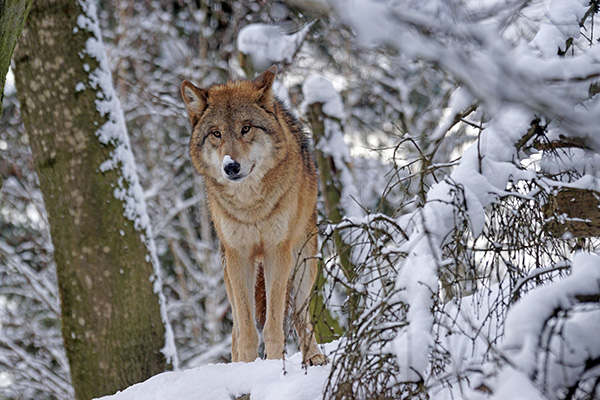
Some distance along the way, he saw three white “immovable objects” facing him and directly in his path. “He came to a halt … and his heart flew into his throat, and he shook all over.” His father’s fear was now his own. Realizing that any sign of retreat might assure his doom, he opened his pocketknife, “drew a long silent breath … and then boldly but cautiously advanced toward the animals, which … stood as motionless as death, their eyes gleaming like balls of fire.”
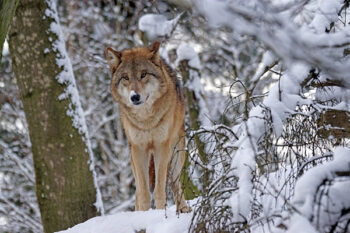
Public domain photo
Suddenly, the stillness of a misty night, was broken by a snort – that recognizable as coming from swine, three of which bounded into the darkness down the valley, “leaving their victim to breathe easier, recover his nerves” and warily resume his journey.
Those large hogs belonged to William’s father, so refusing the rifle may have been fortunate after all, saving the life of at least one and maybe all three.
McIntire informed that in those early days, especially near a big spring, Badger Valley was a runway for wolves, seeking a drink of water in summer and also winter if free of ice. Although a nighttime human traveler would be in danger, records show it was only deer, also drawn to the spring, that were known to be victims of wolves.
However, from that same decade, some wolves did benefit from an unfortunate traveler who also refused overnight accommodations. In sparsely-populated frontier areas, itinerant Methodist Episcopal preachers, known as “circuit riders” or “exhorters” were assigned to preach to fledgling congregations.
On December 9, 1855, Rev. Ranson (Runson) Scott had walked eight miles from his uncle’s house to Portland Prairie, an area approximately seven miles south of Caledonia and a mile-and-a-half north of Eitzen, only to learn a snowstorm had canceled the worship service. The 29 year-old turned down an invitation to stay overnight and about 3 p.m. headed back on foot toward his uncle’s house.
He was not expected back home in such a storm. In those days, there were no fences to guide him home, and the road would soon be drifted full. It was several days later his friends learned he had started for home. Several days of searching turned up nothing. Months later, in the spring, some of his remains were discovered accidentally in a ravine about two miles beyond his uncle’s home.
All that was found of his body were fragments of his lower legs, with his feet still in his boots. His skull was later found elsewhere. His Bible, hymnbook, pocketbook and pocketknife were also found. It is possible wolves killed him, but more likely devoured him after he froze to death.
At some point in time, a song or poem commemorated his life and passing. The date is wrong, and there were surely no cotton fields in southeastern Minnesota. At age 29, he was more “young parson” than “old parson,” but the Ballad of Runson Scott read :
The winter of forty-eight broke cold and lean
With frost on the fields where the cotton had been
Through the red clay hills and the pine-heavy air,
Reverend Runson Scott carried more than a prayer.
With a Bible worn thin and a coat patched with gray,
He’d saddle his horse at the breaking of day,
To answer a calling that kept him from rest:
To tend to the broken, the poor and the blest.
He spoke not in thunder, nor hellfire and dread,
But of grace for the living and peace for the dead.
His voice was a river, both steady and deep,
That quieted doubts when the valley was steep.
By the light of a lantern in
cabins of log,
Through the heat of the
June-bug, the chill of the fog,
He sat with the sick and he wept with the old,
And brought a fierce warmth to a world growing cold.
They say on the night the old parson passed,
The wind through the valley was whispering fast.
The church bells rang out though the belfry was bare,
A final sweet echo of Runson’s
last prayer.
The hands that he healed and
the souls that he fed,
Still walk in the light of the words that he said.
For the path of the righteous is never quite gone,
And the faith of old Runson
keeps traveling on.
Sources:“The Yucatan Valley In the Early Day by One Then There” by Captain Samuel Bates McIntire, 1901, originally published serially by the Houston Valley Signal. “Semi-Centennial of the Church at Caledonia,” 1910.
Leave a Reply