
Photo by SimplyMary
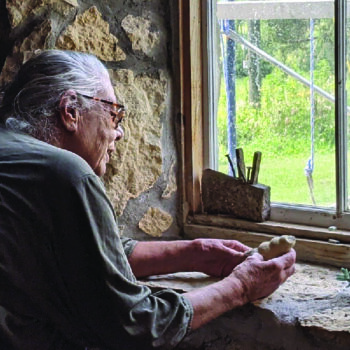
Photo by SimplyMary
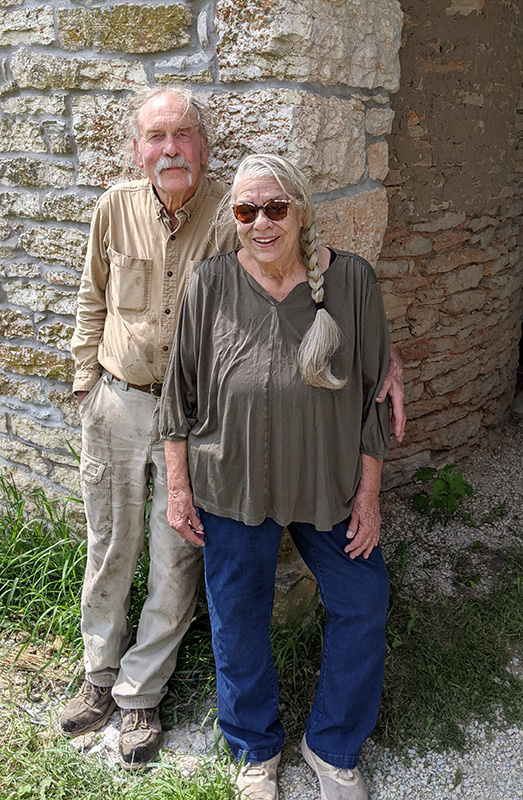
When history is written in stone, preserving it takes a great deal of planning, an eye for detail, and hard physical labor. Gary and Deb (Olsen) Anderson of rural Chatfield indeed have a desire to maintain the history of a Fillmore County stone barn.
This couple not only has studied the historic account of Thomas Ferguson, who along with his wife Jane and seven children (Eliza, Samuel, Euphemia, Jeannie, John, Thomas Jr, and Violet) worked for 22 years to complete this amazing structure, but they plan to preserve the integrity of this three story barn. It is said that each stone was placed by Thomas, who was 71 years old when the stone dated 1912 was secured above the west archway.
The stones for this building were quarried on the farm and a mortar was made with the limestone (crushed into powder) sand, and water. Thomas had learned the trade of stone masonry in Scotland and used his skill to create many stone structures in the area. Among these are: two houses on county road 38 and the Jordan Town Hall. A schoolhouse and another residence were also built by him but have been destroyed.
The story of how Gary, a 1973 electrical engineering graduate of South Dakota School of Mines & Technology (born and raised in Fillmore County) connected with Deb, a 1973 biology graduate from the University of Minnesota (living in Bloomington, Minnesota) is a delightful tale. Their sharing of these early days involving summer camping on the farm with college friends, prairie flowers, and learning to drive a tractor is fascinating.
The interest Deb and Gary have in studying history and preserving the stone barn and surrounding prairie land for generations to come is inspiring. Many in Fillmore County are unaware of this stone barn built by Thomas Ferguson who purchased his homestead in 1871 and engineered this building. Interesting features are recorded in an old quotation by the granddaughter of Thomas Ferguson, Marguerite Asher, who shared, “The very large barn is 100- x 40-ft rectangular. The north half has two stories built in the 1880s. The second story, besides being used for storing hay, had two 1,000 and four 500 bushel grain bins to hold the grain from his nearly 500 acre farm. In the back of the horse and cow barn a large root cellar was built under the hay ramp. In 1912 he completed a three-story addition joined to the other half by an archway through which one drove to reach the house. This addition contained a 12-foot diameter silo [of] three-story height. The bridge spanning the length of the barn and over the drive was used to unload hay and grain.”
Gary explains that in order to get a load of hay or grain into the top floor of the barn, a blind horse was used. The stone walls of the barn are about two feet thick, straight, and solid. The mortar was made from the limestone taken from the field, heated, then cooled, crushed into powder with which sand and water were added. This mortar allowed for the expansion and contraction as weather changes came throughout the years.
The traditional method of making limestone mortar has given way to modern methods. Removing the older mortar and replacing it by hand is a difficult and time consuming task. “I was having a hard time finding a stonemason to consider the job of tuckpointing the barn. Someone said it would take three men, three years to complete the stone barn.” said Gary. “One day, I was coming out of Jack’s in Chatfield and I saw a man working on the old newspaper building and asked him if he had an interest in tuckpointing the stone barn.”
After looking over the barn, three men from Dew Construction (phone 507-400-5200) began the work of tuckpointing. Dean Waas and his two sons, Dean Junior and Jericho of Hayfield, Minnesota, are in their second summer and plan to finish the tuckpointing next year. It is interesting that a man and his family built this structure and now over 100 years later, a father and his sons are securing its future. About 10,000 pounds of powder mortar have been used so far on the stone barn.
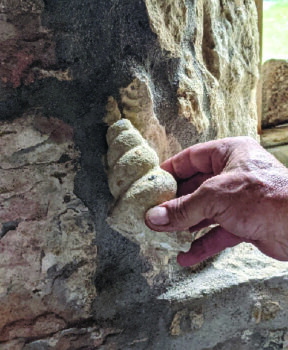
Photo by SimplyMary
The process of tuckpointing is multifaceted.
Steps
• Clean out the old mortar – to remove dust or loose dirt.
• Mix the mortar – it should be smooth and thick like peanut butter.
• Dampen all area stones so moisture is not pulled out of fresh mortar.
• Apply mortar with trowel
• Pack and smooth mortar
Dean remarked, “My boys love working at Gary and Deb’s. We grid hammer the old weathered mortar out and use mini cement pumps to fill and hand tools like tuck point tools, house brush, and trowels to finish.”
Dean continued, “Finding unusual fossils, nails, and other items from long ago has been great. We appreciate being able to work on the stone barn and are falling in love with this building. Gary and Deb’s hospitality is outstanding and we are grateful to work with such good people.”
Deb concludes, “We have been fortunate to work with so many friendly craftsmen who appreciate this building. It’s such a thrill to see the line where the older mortar and the new mortar meet. We are hoping the barn will stand for another 100 years!”
The stone barn is located about seven miles west of Chatfield on 171th Avenue and the Andersons welcome visitors!
Darold Olson says
I visited the Anderson’s several years ago. My cousin and his wife, Carmen and Juliet Campbell, from Lanesboro lived on this farm years ago. Gary and Deb Anderson are lovely people and we had a great visit. Bob Ellis grew up
Spitting distance from this farm. Darold
Jean Strange says
It is an absolutely beautiful place owned and cared for by 2 wonderful people!