


Photo by Wanda Hanson
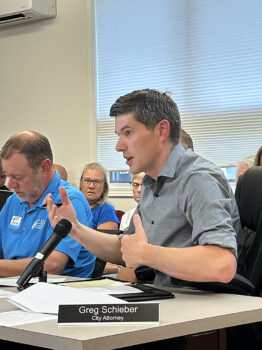
Photo by Wanda Hanson

Photo by Wanda Hanson
Another joint meeting of the Harmony City Council, Planning and Zoning and EDA was held August 26 after written comments and questions from the public about the proposed data center ordinance were collected over the past two weeks. A total of 42 submissions were sent to the group. City Attorney Greg Schieber and City Administrator Alissa Stelpfug organized the input and created a summary of the comments. Members of the joint group were given both the individual comments and the summary.
The room was crowded with residents as Schieber presented the summary for the group to discuss. The public was not allowed to speak as the group discussed changes to the proposed ordinance.
Mayor Steve Donney reminded the public they had several chances to speak earlier in the process and would again be able to speak when a public hearing was held. The group needed to go through the suggestions and discuss what changes they felt should be made.
Schieber presented the suggestions by theme in the order the topics appear in the proposed ordinance. One of the first items he brought up was the definition of a closed loop system. He felt the document should be clarified as to whether that meant absolutely no water use or only when maintaining the system.
Councilman Kyle Scheevel asked if the system would perhaps need to be primed with water. The cooling tower would be similar to a boiler in a home according to Stuart Morem of the EDA. Donney pointed out that corn-based glycol can be used for cooling for a period of eight to 10 years. Ultimately, the group decided that water could be used for maintenance, but zero water should be used in normal operation. Stelpflug clarified that the water usage limit of 60,000 gallons was per month and was based on the usage of the school and large businesses in town.
A retention pond will be required for runoff; the data center will not be allowed to dig its own well, but must get water from the city. Copies of assessments of land done by the engineers will need to be submitted. The group wants to assure that there will be no adverse affect on the karst of the srea.
The size of the building will need to be included in the CUP application. Any changes to the size would force the business to return; the data center could not be built in phases without an additional CUP and public hearing.
Any required testing will be paid for by the applicant. If on-going monitoring is required that also will be paid by the applicant.
The state governs the noise; the local government cannot set its own limits. The group decided monitoring of the noise level should be done quarterly by a third party which is approved by the city. This would be paid for by the applicant as well.
Stuart Morem pointed out that once a contractor is chosen, the engineer should be able to get a printout of what the decibel levels would be. He suggested including a requirement of such a printout in the CUP application.
Schieber reminded the group that they need not allow any variances; they can set the standards and stick to them.
The group decided to change the height to be allowed for the building. It had been arbitrarily set at 60 feet. Stuart Morem suggested a height of 40 feet all inclusive. Any ventilation systems or wind baffling need to be below that height.
Setbacks were changed to 300 feet in all cases with the exception of 400 feet for ag and 500 feet for residential.
Parking and emergency service plans will be shared with the fire department and police to get their input on the suitability. Approval from them will be a part of the CUP.
Annual reporting will have a deadline date for submission. Electricity use information could be obtained from MiEnergy. Generator run-time could be supplied by the applicant or the city could have an employee read the meter. The applicant will need to be emissions compliant with the EPA. The city will retain the right to inspect the property if any information is questioned.
Schieber called the community benefits section of the ordinance vague and general; he noted that the best way to reap the benefits is through the selling of electricity and property taxes. The group decided to include “the city shall” instead of “the city may;” this means the city must decide on any additional community benefits to be required in the CUP.
In the transparency section, any exception was deleted. The group was fine with simply stating that the city will not sign non-disclosure agreements.
Other questions from public comment asked if ownership of the property could be restricted to U.S. companies. Schreiber shared that they could not do this legally.
A question about allowing the citizens to vote on the subject was asked. Schieber replied that wasn’t allowed in Minnesota (unlike California), but they could do a public survey.
The group decided to clarify that the applicant must follow state and federal laws as well as the CUP.
Mayor Donney reminded the public they can still talk to any of the members of the group or send in comments. He commented, “This is the first step. It’s not saying yes, it’s not saying no. It’s saying we’re gonna to look at them potentially to see what they have to offer.”
The notes from this meeting will be shared with Attorney Soren Mattick for inclusion in the fifth draft of the ordinance. Another joint group meeting will be held on Wednesday, September 16 at 6 p.m. providing that Mattick will be available either in person or by Zoom then.
The next steps after that will be to turn the ordinance over to Planning and Zoning for its recommendation. A public hearing will be held at a special council meeting after P & Z makes its recommendation. The date for the public hearing has not been set.
Leave a Reply