
By Cheryl Boyum Eaton
Peterson Museum Board Member
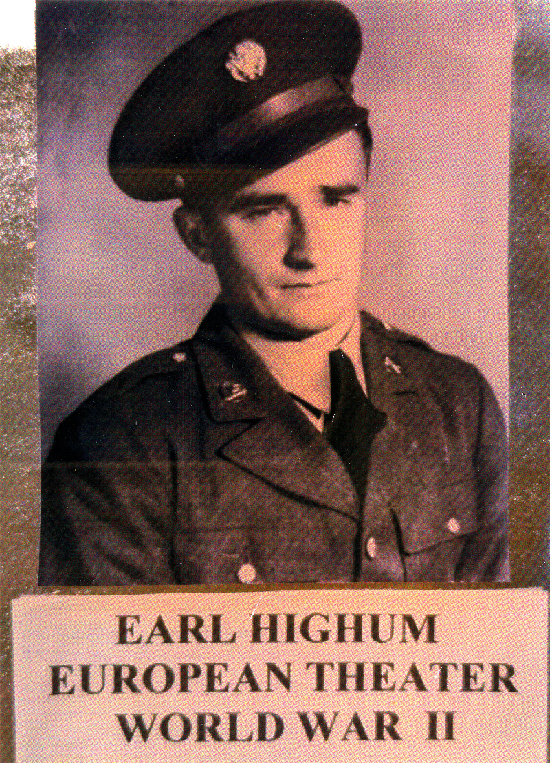
On October 5, 2025, Olaf Minge and Kyle Ward came to Peterson, Minnesota, to talk about the Viking Battalion. They had previously visited the Peterson Station Museum, where volunteer Gail Boyum pointed out the World War II uniform of Earl Highum who had served in this battalion – noted by the Viking ship patch on his uniform that is preserved there. They had published a book, “The Viking Battalion,” in 2023 and were interested in sharing their information.
A little information on these editors. They chose “editors” as the book is mostly stories written by the actual 99th Battalion soldiers or their descendants. There are three editors: Olaf Minge, the grandson of a doctor that was attached to the 99th; Kyle Ward, of Norwegian descent, director of Social Studies Education at Mankato State University, and instructor of classes on World War II; and Erick Brun, the son of a Norwegian emigrant who served in the 99th.
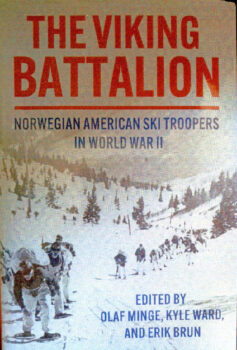
Photo courtesy of Peterson Station Museum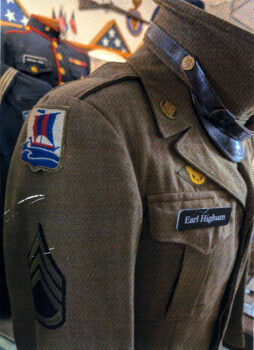
Photo courtesy of Peterson Station Museum
The 99th was formed at Camp Ripley in July 1942 in response to Germany invading Norway on April 9, 1940. Norway, who had hoped to remain neutral, held out until June 10 after King Haakon escaped to London on June 7. Norway was now occupied by 350,000 military men plus their equipment.
A call went out to all American forts about a battalion being formed to invade Norway. All soldiers entering the army were initially asked if they spoke a foreign language, so the 99th was formed from escaped Norwegian citizens, Merchant Marines, and Americans fluent in Norwegian. In September 1942, the battalion was moved to Fort Snelling where they were put through grueling speed marches to eliminate all who were not physically fit. The group was whittled down to 1,000 men.
They then moved to the Camp Hale Mountain Training Center in Colorado. The facility had up-to-date plumbing and heating, but the soldiers said they rarely got to use them because they were camping out in the mountains – training! Here they were issued packs weighing from 70 to 97 pounds, depending on their mission in the battalion. These soldiers averaged five feet eight inches tall and weighed about 145 pounds. On August 24, 1943, they were told to leave their winter gear, they were moved to New York, boarded the S.S. Mexico and arrived in Scotland on August 27, 1943. Here they received infantry and weapons training with 20-mile hikes daily. Later they were moved to Wales and maneuvered every mountain peak with tanks and live ammunition, moving again in May 1944 to an area near Hereford, England.
This unit was never kept secret. News articles and newscasts were frequent. Some speculate it was the plan, to keep the 350,000 Germans in Norway so they would not be available for the D-Day landing, just as General Patton’s army was used as a decoy opposite Calais, where Hitler was certain the invasion would occur.
The 99th Battalion left for France on June 21, landing on shell-torn Omaha Beach. They were attached to Omar Bradley’s First army, helped secure and patrol Cherbourg, were stationed at Malmedy, Belgium during much of the Battle of the Bulge. After this they were attached to General Patton’s Third Army and assisted in liberating concentration camps. At Buchenwald, when General Eisenhower toured it, he ordered all army units to tour the camp and see first hand the atrocities, to have eye witnesses thereof.
The 99th participated in Mercker’s Mine. They were Monument Men, whose mission was to preserve art and other valuables the Nazis had stolen. They provided trucks and men to transport this “loot’ and gold to safety before the Russian troops arrived.
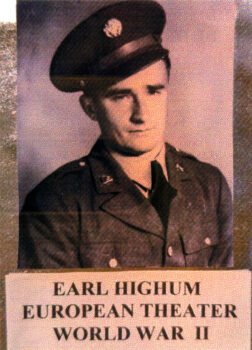
Photo courtesy of Peterson Station Museum
After the Germans surrendered on May 8, 1945, there was a question, “What would now happen to the 99th Battalion?” They were finally sent to Norway as the honor guard for King Haakon’s return and to transition the Germans out of Norway. This became their last mission.
Three direct family members attended this program, Terry and Louise Highum, two of Earl’s children, and Lee Humble, son of James Humble of Rushford Minnesota, who was also a member of the 99th.
Terry stated that his dad rarely spoke about the war, but did say the time he spent at Malmedy “was miserable, cold and wet.” He related a story that once his dad went skiing after the war, he lost one ski on the way down a slope and just continued skiing on one ski to the bottom. Training paid off! Louise remembered that Earl was an Army cook and could crack four eggs at one time! Lee related that his dad was wounded in a leg during the Battle of the Bulge on December 28, 1944. He was sent back to the United States to an army hospital in Topeka, Kansas, where they were able to save his leg.
The battalion received many medals, some from America and others from Norway and Allied nations. Camp Ripley, north of Little Falls, Minnesota, is opening a new Military and Veterans Museum this September and Camp Hale has been made a national park. Thank you to all veterans for your service securing our freedom for 250 years!
References: The 1877 Peterson Station Museum: The book The Viking Battalion and the presentation by Olaf Minge and Kyle Ward on October 5, 2025.
Leave a Reply