

By Sally Ryman
Rushford Historical Society
Ever wonder how your hometown came to be? What caused it to grow and thrive? This is the story of Rushford’s early years.
Native Americans had lived in the area for thousands of years, but we will begin in 1854 when white settlers arrived. Rushford started as a shanty town of about 20 log houses. Area farmers were beginning to produce crops and animals beyond their needs, creating a need to reach eastern markets. Initially, Indian trails evolved into territorial roads. Then there was a short period of steamboats on the Root from the Mississippi to Rushford.
In 1866, Charles D. Sherwood, Dr. Luke Miller, B.D. Sprague, Hiram Walker and C.G. Wykoff successfully lobbied Congress and the State Legislature to bring the railroad to Rushford.
The arrival of the Southern Minnesota Railroad in 1867 turned Rushford into a “boom town” of commercial activity. The population swelled to 1,600. More than 150 buildings were constructed that year, including 35 stores, seven grain warehouses, five hotels, two bridges, two breweries, 18 saloons, seven churches, and the Depot.
Incorporation as a city occurred the following year. Due to a clerical error, it was incorporated as a city rather than a village, which created considerable problems with the township years later. In 1885 the farmers, fearing the spread of the city and encroachment of their land, incorporated the entire township as the Village of Rushford. The newly-incorporated village surrounded the City of Rushford and the Village of Peterson – a situation so unique that it was reported in the nationally syndicated newspaper column Ripley’s “Believe It Or Not” in 1938.
By 1870, Rushford was no longer the western terminus of the railroad and ceased to be a booming frontier town. The unprecedented growth slowed, but the people who remained were those who bet on the development of the town. Businesses included grocery, dry goods, clothing stores, tailors, butchers and meat markets, cafes and confectioneries, pharmacists, hardware stores, jewelry stores, beauticians, tonsorial saloons/barbers, funeral parlors, and furniture stores.
Railroad business grew, and the Southern Minnesota Railway expanded the depot. The August 1, 1878, Preston Republican noted that Rushford’s depot was “both the largest and best one along the line of road. It is a two-story frame building, the upper portion of which is used as a residence.” This picture of the depot in the early 1900s is thought to be very similar to what it would have looked like in 1878.
In 1880, the Milwaukee Road took over the busy depot. It was one of the busiest depots between La Crosse and Austin, often running freight trains of over 30 loaded cars – big for that era. It received lumber, merchandise, and manufacturer shipments. Timothy seed, grain, flour, eggs, butter, wool, hides, livestock, and Rushford Wagons were shipped out. And, of course, passenger trains transported people to and from Rushford.
These were the early years of Rushford – 1854 to early 1900s.
Sources: Dr. Droivold’s “The History of Rushford: Volume I The First Decade” & “Volume II Railroad Boom Town.”
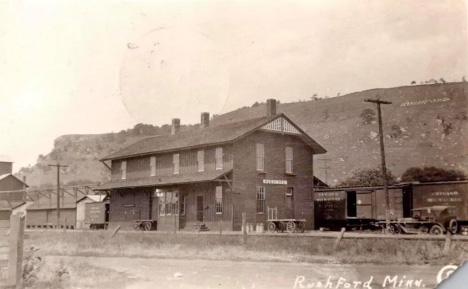
Photo submitted by Preston Colbenson