
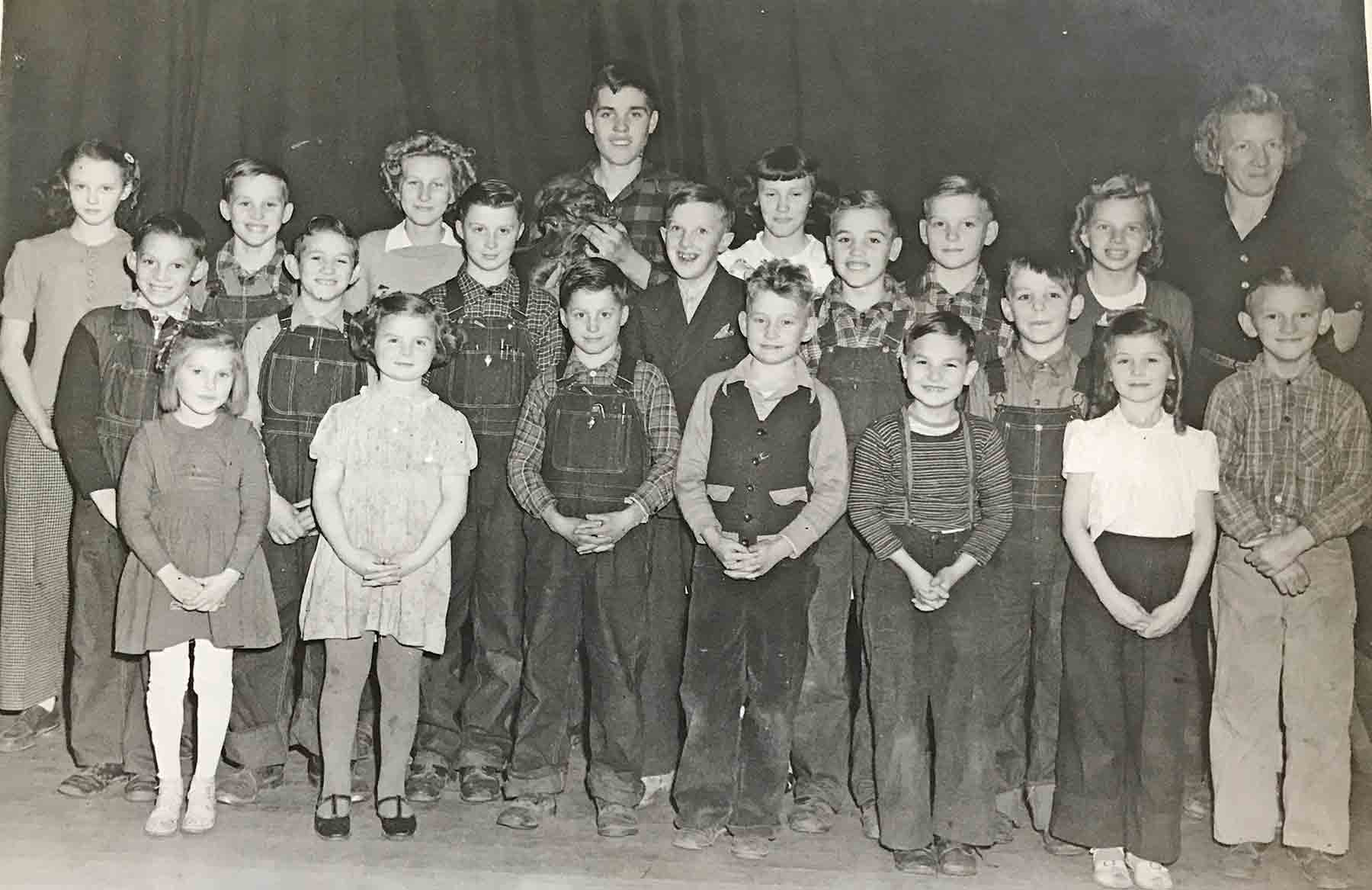
Photo submitted by Wayne Sievers
With all the hype about back to school — the sales, the “necessities,” the preparation — you might wonder what school was like in the simpler times of the old country school.
The following people were willing to share their memories of their country schools: Kathy Eide, Wilton Center near Harmony; Audrey Cremer, Florenceville in Iowa and Granger in Minnesota; Georgia Hermanson, Granger; Pat Soland, Bristol Grove near Preston; Jerome O’Connor, Crystal Springs southwest of Preston; Dave Wissing, Hazel Prairie in the Greenleafton area; Paul Dvorak, Vinegar Hill School near Rushford; Wayne Sievers, Hart Public and St. John’s at Hart near Rushford.
Audrey Cremer told of her mother ordering a few new things from the Montgomery Ward catalog for school and then sewing her some dresses from feed sack fabric, which she would wear with long cotton stockings that used a garter belt.
Wayne Sievers of Hart said that as the youngest of seven kids, he simply wore hand-me-downs from his siblings.
No yellow school buses roamed the countryside at that time. Instead the students arrived in assorted ways. While many walked to school every day no matter the weather, Pat Soland rode her horse to school and staked it out to graze until it was time to head home. Jerome O’Connor who lived a “short half mile” from school never had a ride, but would slide to school on icy days on his sled.
The typical schoolhouse was a one-room house with an entryway at the front which served as a coat room. Desks were in rows, often fastened together, with a table at the front and a teacher’s desk. The teacher would hold classes at the front table while other students were expected to work independently at their desks until it was their turn.
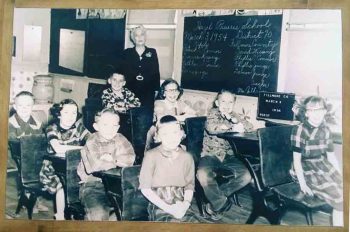
Photo submitted by Dave Wissing
Georgia Hermanson described Granger School, however, as a big square building that had also contained the high school in previous years. The school had two curving staircases leading to the upper level.
Wayne Sievers, who “had trouble sitting still,” liked listening in on the older students’ lessons. Dave Wissing and Georgia Hermanson both mentioned listening to other classes’ lessons helped them if they’d forgotten something and kept them learning new topics from the older classes.
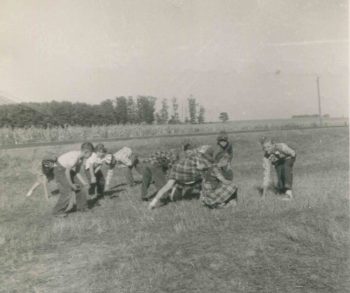
Photo submitted by Pat Soland
Virtually everyone remembered learning to read with Dick, Jane and Sally’s escapades. O’Connor had fond memories of math flash cards and current events once a week as well as an emphasis on spelling and phonics. He chuckled that “potato” was often misspelled in their spelling bees.
Hermanson recalled the penmanship lessons where they all learned to read and write cursive fluently. After lunch the teacher would always read a chapter of a library book; this was something they all eagerly anticipated.
Class sizes were very small; Eide shared there was only one other girl in her grade and not more than eight in her school. She and her siblings attended Wilton Center as did three or four generations of her family.
Hazel Prairie also had eight students; Wissing was one of three in his class until one boy moved away. Wissing declared, “Then I was the salutatorian of my class!”
Soland had two boys in her class besides her while Dvorak had four in his class and 12 total at his school.
Cremer was actually the only student in her class when she was in sixth grade so the teacher moved her to seventh grade. The superintendent got upset about that and made Audrey take seventh grade a second time. That year she basically just helped the teacher.
Lunchtime at the county schools meant getting out your lunch pail that you’d brought from home. Kathy Eide remembers occasionally a thermos of soup as a special treat, if she was lucky. Pat Soland found sandwiches and cookies in her dinner pail. Georgia Hermanson usually went home for lunch, but sometimes brought her lunch to school just for fun.
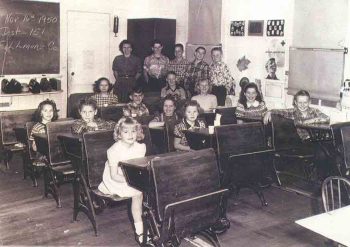
Photo submitted by Pat Soland
Sometimes Audrey Cremer’s teacher would cook up a pot of soup in the wintertime. Jerome O’Connor said that with 12 kids in the family, lunch was usually peanut butter sandwiches and an orange. His school had a big oil burner for heat; the teacher would put potatoes in foil to be ready for noon lunch. Later a hot plate was added to heat up meals, but Jerome preferred his peanut butter.
Wayne Sievers remembers his homemade bread and homemade summer sausage sandwiches that he brought in an old syrup pail.
Water for the schools was usually carried in pails from nearby farms by a couple students each day. The water was then poured into stone crocks, most of which had a button or spigot at the bottom to dispense the water. The Granger school had its own outdoor pump for water. Cremer remembers using a ladle to get the water from a crock and making her own paper cone cup to drink from. Other schools supplied purchased paper cone cups. Crystal Springs got its water from the nearby spring until the state insisted the water come from a well.
At Vinegar Hill, Dvorak said the water crock had a bubbler on top to drink from with a pail underneath it to catch the waste water. Dvorak hauled water to the school after he graduated from high school while farming with his dad, until the school closed.
Recess games at the country schools consisted of Auntie I Over, Red Rover, Hide-n-Seek, Pom Pom Pull Away, softball, and football. Granger School had lots of big swings and sumac trees where the girls used to play house. In the winter, building snowmen and snow forts, snowball fights, and Fox and Goose kept the students busy outside. At Crystal Springs, O’Connor played dodgeball in the basement in inclement weather. Wissing remembers square dancing; he was happy when that was over since he was always promenading when he should have been he should have been do si do-ing!
The Christmas program was an important event at country schools. Fathers would string a wire to hold a curtain for the stage. Every child would be assigned a “recitation” to memorize. Students enjoyed getting out of regular classes to practice for the program, but some like Pat Soland were shy and wouldn’t do their “piece.” Santa sometimes visited and everyone got an apple.
Another event students looked forward to was Township Days which were held during the school day at different schools on a rotating basis. Lots of the country schools would get together to compete against each other in spelling bees, other academic competitions, softball, and running events.
Audrey Cremer remembered getting a school day off to pick milkweed pods for the WWII war effort. The pods were put in gunnery sacks and sent off to fill life preservers. Cremer noted she had fond memories of grade school.
Kathy Eide declared, “Those were the good old days!”
Georgia Hermanson enthused, “We got a good education in the country school!” Hopefully, today’s students will be able to declare the same!
Sandra Miller says
Myrl Cady was born on January 1, 1920 and died on August 1, 1996, at Bassett Township Rock County, Nebraska. Myrl had two wives Ruby and Delma. Myrl and Ruby are buried at East Park Cemetery, Ainsworth, Brown County Nebraska. This information is from Find A Grave.
His Nebraska Draft Registration on July 1, 1941, indicates his residence in Woodlake, Cherry County Nebraska. but he was a farmer in Athena, Oregon.
I’m not sure if this is the Merle Cady you were inquring about.
Laura Pederson says
I am looking for the Cady family that lived up a hill by an old schoolhouse that had a massive rock by it. Not sure of the surname spelling but there was a Cecil and a Merle .Merle may have spent time in St.Peter and the family later rented the farm to a Glen and Evelyn Stange. Time frame possibly late 40s?
Sandra Miller says
Myrl Cady was born on January 1, 1920 and died on August 1, 1996, at Bassett Township Rock County, Nebraska. Myrl had two wives Ruby and Delma. Myrl and Ruby are buried at East Park Cemetery, Ainsworth, Brown County Nebraska. This information is from Find A Grave.
His Nebraska Draft Registration on July 1, 1941, indicates his residence in Woodlake, Cherry County Nebraska. but he was a farmer in Athena, Oregon.
I’m not sure if this is the Merle Cady you were inquring about.