By Maddie Smith
Minnesota State FFA Treasurer
Leaving home on New Year’s Day, there was no knowing what the next three weeks had in store for me. Beginning in New York City, 75 FFA members prepared for a trip, the International Leadership Seminar for State Officers, to Spain and Portugal to obtain a global perspective of agriculture. Officers came from across the country: Alaska, Florida, Oregon, and everywhere between.
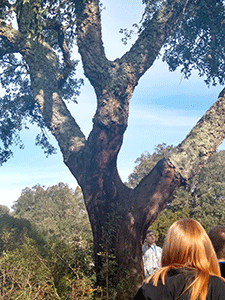
Touring the agricultural industries in Spain, and Portugal, we visited several vineyards and wineries with art and citrus fruits, a John Deere dealership, beef and olive farms, cork tree forests, and the “Plastic Sea.”
As exporters of 44% of the global supply, Spain’s largest commodity is olive oil. In Portugal, four 15-acre factories process 60% of the world’s supply of cork, which is used for shoes, jewelry, bags, and even NASA products. However, 70% of their total cork is used for wine. Most likely, the olive oil you use to cook is from Spain and the cork you pull from a wine bottle is from Portugal.
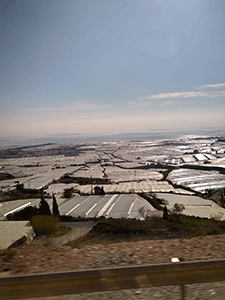
After a 60-mile drive through the mountains and by the Mediterranean Sea, we spent over an hour viewing only a portion of what is known as the “Plastic Sea.” The Plastic Sea consists of 77,000 acres of greenhouses filled with plants growing produce like tomatoes and peppers. If you were to imagine every hay, corn, and soybean field covered with white greenhouse tarp, that’s what their mountainous landscape looks like.
Most beef cattle in Fillmore County and the U.S. are black Angus. On one Spanish ranch with 6,000 head of cattle, every cow and bull was either a white Charolais or Limousin, which aren’t unknown to our area. They didn’t dehorn or castrate any of their livestock, however.
As part of the European Union (EU), Spain and Portugal are under strict restraint against using any form of Genetically Modified Organisms (GMOs) or performing any practices which they believed caused stress for the animal. In the United States, it is a common practice to dehorn and castrate cattle for animal and human safety and quality meat products.
Like the EU, growing organic crops is practiced in the U.S. However, genetically modified (GM) crops are banned in the EU. Growing GM crops such as corn and soybeans (which are our largest agricultural exports) is used to grow a majority of our disease-resistant crops in higher yields. The U.S. has diverse methods of production, which includes practice from GM crops to organic. Because of policy, EU farmers have limited production options, and, for this reason, the EU is unlikely to import U.S. products such as corn and soybeans in the near future.
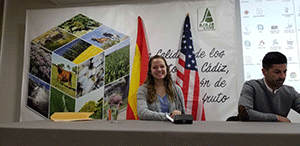
In the U.S., the USDA is the primary executive department for agriculture. In Spain, the Asaja Asociación Agraria de Jóvenes Agricultores (ASAJA) is the primary agricultural leadership department. We visited with Spaniard farmers at ASAJA and, in Portugal, we met with the U.S. Ambassador to Portugal to discuss current policy and diplomacy between our countries.
During our time at ASAJA, a panel discussed four topics that are relevant to both Spain and the U.S.: challenges and opportunities for our farmers, access to land, generational renewal, and crop trends. Each topic had a Spaniard and FFA speaker, with a translator to complete communication.
I had the opportunity to speak on behalf of American crop trends to highlight our challenge in trade and the importance of the United States Mexico Canada Agreement (USMCA) for our farmers; our diverse production methods; and emerging markets such as cannabis, organic, and specialty crop farming. We focused on the FFA emblem, which contains a cross-section of corn, representing unity as corn is grown in all 50 states.
The single, most impactful moment for me from the entire journey was when a young Spanish farmer talked about how his farm has been in his family for so long that they had lost count of how many generations and centuries it has been operating. While discussing generational renewal, he said (in Spanish), “farming isn’t a job, it’s a lifestyle.” Word-for-word, these are words I have heard on my own farm, out of my dad’s mouth. These words have been said across Fillmore County, and I’ve heard them throughout my travels across Minnesota and the U.S.
There is unity in agriculture across not just the U.S., but across the world. Farmers in Spain and Portugal contain the same values as American farmers: animal and consumer safety, quality products, and pride for what they grow–even if we demonstrate these values through different practices
In terms of agriculture, one of our greatest assets here at home lies in our education. In Minnesota alone, 27,000 members are enrolled in middle and high school agriculture classes. Nearly 11,000 of those students are involved in FFA, and across the country, that number totals to over 700,000. Neither Spain nor Portugal are as fortunate to have agricultural education as we do.
As a consumer, I want to know that my food is produced safely; as a producer, I want consumers to know how much care we put into our food. I’ve been fortunate enough to explore both perspectives, and I wish for others to be able to as well. After all, farmers across the world see farming as more than just a job; it’s a lifestyle.
After a January filled with eight flights, safe travels to North Carolina, NYC, Spain, Portugal, and a brief presence in London with friends from across the country, my trip brought me home to Minnesota seven hours before I began the second semester of classes at the University of Minnesota. While it may have only been a few hours, I was able to rest easy knowing I would be studying agricultural education and eventually telling students about “agricultura a través de el mundo.”