
 By Lee Epps
In pioneer days, an olden-times “writing class” or “writing school” provided a service valued by many adults. It did not teach composition or “creative writing.” Early-day Houston County writing classes featured the most basic skills of penmanship and handwriting – the formation of all the letters in the alphabet, including writing one’s own name.
Whether they came from Europe or the eastern United States, many midwest pioneers in the mid-1800s lacked formal education. The students in those early writing classes were proudly able to sign legal documents with their handwritten name instead of an “X” above the explanation “his or her mark.”
Any educated man desiring to organize and teach a writing class began by answering several questions from the school trustees, who could authorize evening use of the schoolhouse. The teacher was expected to provide pen, ink, paper and chalk for the class. Pupils provided their own lighting items, either a standard molded candle or an inexpensive tallow dip candle, one with a wick submerged into animal fat. When kerosene lamps became available during the Civil War (early 1860s), the pupils would bring a lamp with the teacher furnishing the kerosene.
Writing schools were always held on winter evenings, when the instructor had to bring his own firewood. He often was not inclined to add wood to the fire much past the 7 p.m. starting time, and by session’s end, the building was too cold for socializing.
Those requirements assured the community that no tax money would be spent on anything except the public school. Writing classes were private enterprise, not free public education.
Having secured permission to use the schoolhouse, the teacher became a salesman, visiting the homes of every area family in search of pupils, be they adults or children. As was said, everyone “from age two to toothless” was welcome, provided they had a dollar for tuition.
For that dollar-per-pupil fee, the teacher promised a month of instruction consisting of 20 night sessions for about two hours per session. For it to be a financial success for the instructor, he needed at least 30 students. For comparison, the regular daytime, Mound Prairie public school teacher in the last half of the 1800s earned from $25 to $35 per month.
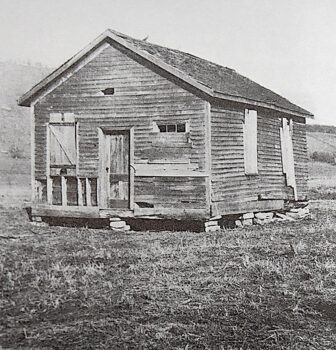
Photo compliments of the Houston County Historical Society
Author Sumner Sheldon was raised in the early 1900s, decades after the writing class era, but he was told by his father, Dr. Giles James Sheldon, “Every writing class we had was taught by a man; all of them past middle age, all experienced, capable teachers with a drinking problem. They could not be relied upon to get through an entire school term without a full blown binge.”
He continued, “We had a teacher, Mr. Webster, who very near the end of his writing class, was called upon to hammer together one of our carpenter-built benches. So tight were his nerves, that when finished with our “school hammer,” he threw it along the floor towards “teacher’s desk.” His aim too good, his arm too strong. The hammer shot under the desk and broke his gallon jug of ink! I never saw a madder man in my life, and the big, black stain was on the floor as long as I went to school.”
At the close of one writing class, Dr. Sheldon was one of three judges called on to recognize the “best writer” and the “most improved.” He informed, “We had about four, maybe five writing classes in our district during the 15 or 20 years they were popular in the county. It took about five years for a new crop of customers to appear for a writing school.”
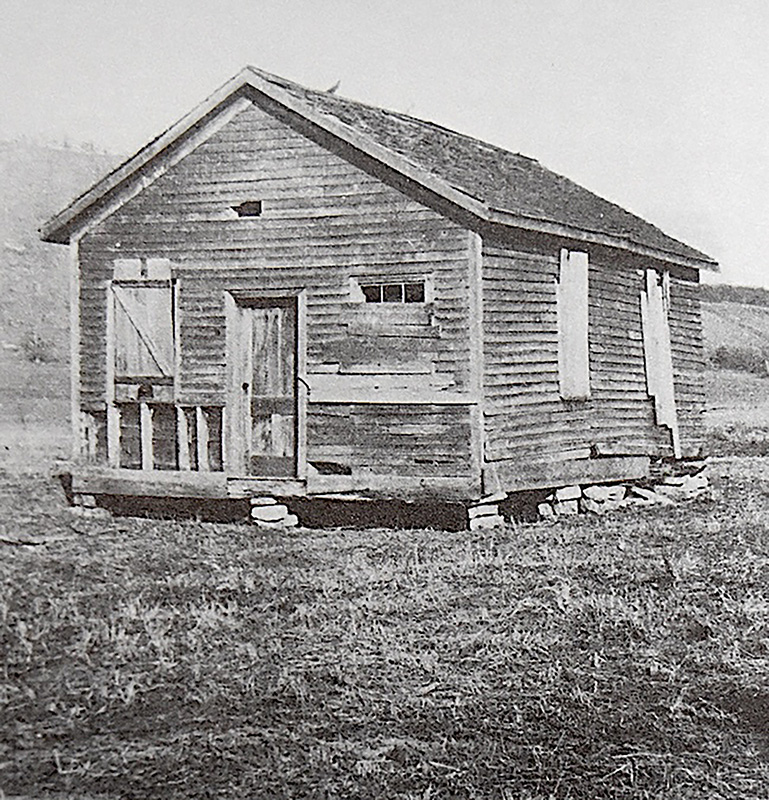
Between 1859 and 1897, the rural Mound Prairie Schoolhouse hosted other community meetings and events beyond regular schooldays, including school student “spelldowns” and neighborhood “spelling bees.” The neighborhood spelling events were organized by unpaid organizers with the intent being “fun, games, amusement, social recreation, anything to combat wintertime social doldrums.”
Both types of spelling events used the same format with contestants “choosing up sides.” Each side or team would line up on opposite sides of the schoolroom. Competitors and sides alternated in oral attempts to correctly spell words pronounced and judged by a competent leader. When not away helping someone enter the world or providing other medical attention, Dr. Sheldon attended many spelling competitions, when he was invariably chosen to pronounce the words and judge the spelling.
As competition continued, round after round, the words became more difficult. Those who did not correctly spell their word were said to have been “spelled down” and eliminated from the competition. Mound Prairie neighborhood spelling bees were most popular as winter diversions during the 1860s and 1870s.
Sumner noted many young people would have attended a spelling competition every week if possible. But unpaid organizers were not that often available. In his schooldays, Sumner said the number of students was low, with not enough kids to “make it competitive and interesting.” Therefore, the school spelldowns were held only once or twice a year and only on Friday afternoons.
His only appearance at a “big-time” spelldown came at eighth grade graduation exercises at Caledonia in August 1923 when he “spelled down” on his very first word. He said he had never before seen the word “apron” in print. “My mom was most discouraged with me, and for years and years, any time she needed my kind of kitchen help, it was “Get yourself an A-P-R-O-N, get out here and get busy.”
Years previous, his older sister had won the Houston County spelling contest, a family tradition he was unable to sustain. A few weeks later in 1923, Wayne Swenson, as a first grader, spelled down the Swede Bottom School on his first day in school. The winning word was “elephant.” Evidently, Wayne was a relative who got “the family tradition back on track in little more than a month.”
Grandma Sheldon, who three times each day baked fresh hot biscuits for grandfather, once spelled down on the word “biscuit.”
Sources: “Now and Then” newspaper columns by Sumner Sheldon, published in the autumn of 1987 by the Houston Gazette and Country Journal.
Leave a Reply