
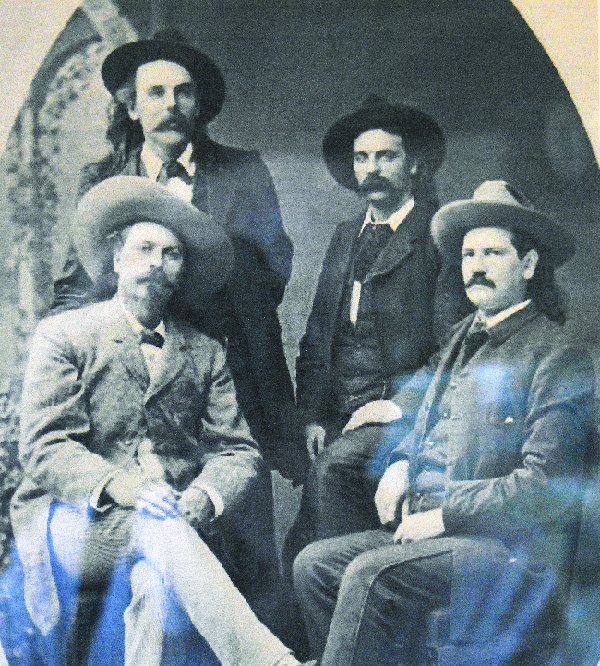
Photo courtesy of the Lanesboro Museum
From Lanesboro to Europe? Buffalo Bill’s Wild West Show was the largest and most attended live, traveling outdoor performance that reenacted scenes of the American west along with exhibitions of sharpshooting and daring horsemanship in both the United States and Europe for three decades, beginning in 1883.
Lanesboro historian Cecil Ward claimed the inspiration and sometime later, the first such performance occurred – in Lanesboro, Minnesota. William Frederick “Buffalo Bill” Cody came to Lanesboro in the late 1870s, or maybe 1880, to visit his old friend Dr. Frank Powell (White Beaver) who practiced medicine there.
The name White Beaver was given to Powell by the local Winnebago Indians, whom he treated without pay. He had been born in Kentucky, his father a doctor of Scotch-Irish descent and his mother a daughter of a Seneca medicine chief.
Cody and Powell, who had been compatriots while serving as western scouts for the U.S. Army, enjoyed their reunion in Lanesboro. One night, after consumption of alcoholic beverages, they rode up and down the street with a revolver in each hand, shooting into the air. The uproar brought droves of Indians into town to rescue their friend White Beaver, who would assure them he was safe. He also rejected his wife’s entreaties to come home. “I am just having myself a bit of fun.”
During that Lanesboro visit, Ward wrote, “Buffalo Bill conceived the idea for his “Wild West Circus” and solicited the partnership of his friend.” And the first performance was also in Lanesboro. A dozen years later, the Lanesboro Journal published an account given by Mr. B. A Man, a participant in that 1881 inaugural performance, featuring “six Indians, two squaws and two white men, together with Buffalo Bill and White Beaver (Dr. Powell).”
That first performance, due to several days of rainy weather, was held indoors on the second floor of Nelson’s Hall. That eliminated the portion of the show in which young Indians on horseback would pick up objects at full gallop.
While Buffalo Bill and the expanded show would go on to international acclaim, White Beaver remained a practicing physician, having relocated in La Crosse, Wis. He had been so respected in Lanesboro, wrote Ward, that “they came from near and far to consult him … Dr. Powell performed the first appendectomy on record (in the area?) on a farmer living three miles southeast from Whalan.”
Cecil Ward wrote of his father C. A. Ward, who as a youth had his eye problems “cured slick as a whistle” by Dr. Powell, who kept him in a dark room for a week or 10 days. Even at age 87, he could see well without glasses except for reading.
Both Buffalo Bill and White Beaver were “crack shots.” Ward related that his uncle, Frank Bergey, as a boy, “was proud to stand and let the great scout (Cody) shoot apples off his head.”
An undated newspaper clipping told of “Buffalo Bill (Wm. F. Cody), the great scout, astonished the citizens of Lanesboro the other day by performing some really wonderful feats of marksmanship. A lady placed a potato on her head, which he severed in twain at ten paces with his trusty rifle. Dr. Powell held a silver half dollar between his thumb and finger and permitted Cody to drive a bullet through it at the distance of ten paces. Mr. Geo. E. Powell (White Beaver’s brother) allowed him to shoot the ashes from his cigar, while smoking it, at ten paces.”
While Buffalo Bill would take his shooting prowess on the road, White Beaver, in La Crosse, demonstrated his firing finesse only “to gratify a few friends” plus a Houston newspaper reporter, who witnessed these feats in the doctor’s office in 1884. “The doctor first showed us position shooting. Sitting in a chair with his back to the target, holding a looking glass before him, and aiming through the same, he would hit his mark every time. He then exhibited some more difficult position shots, such as lying on his back, holding the rifle with the “sight” down, and in these and many other positions, he would shoot and hit a small cork, suspended in the air by a cord, and fastened to a chandelier. He shot the ashes from a cigar, held by an assistant, shot a cork off his hat, which was placed on the head of one of the spectators, shot a pellet (the smallest kind made) out of a loop, said loop was made of thread, and the last, and we thought the most difficult, was the cutting into a hair, which was pulled out of an Indian scalp … The shooting was all done with a No. 22 cartridge rifle, and at a distance of about sixty feet. “White Beaver” by which name he is familiarly known, might make a barrel of money by his exhibitions, but he seems to prefer to entertain those whom he likes, and only shoots for the pleasure it gives them.”
Dr. Powell created a line of very popular medical products, which he marketed under the White Beaver brand name and were sold by many stores in towns surrounding La Crosse. A Houston Valley Signal edition of 1884 stated, “White Beaver’s Yosemite Yarrow is what will cure rheumatism. Many of our citizens have given it a fair trial, and all pronounce it the best medicine for that purpose.”
While Buffalo Bill took his elaborate, staged portrayals of the west to two continents, White Beaver educated smaller audiences who attended a series of his lectures in La Crosse, starting in December 1883.
In the spring of 1884, a group of intoxicated Sioux, masquerading as Winnebagos, came to Dr. Powell’s office with intent to avenge White Beaver having killed a Sioux named Yellow Hair. After a pistol failed to fire, a three-minute struggle ended with White Beaver killing the party’s leader with a pistol blow to the head.
In the spring of 1885, Dr. Frank Powell was elected mayor of La Crosse.
Sources: Native American Excerpts from Early Newspapers in Houston, Fillmore, and Winona Counties of Minnesota, by Paul Wiste, 2026, courtesy of the Houston County Historical Society; biographical essay, “Buffalo Bill Cody” by Cecil Ward; Lanesboro newspaper article “The Story of Lanesboro by Cecil Ward, May 29, 1969; other ephemera at the Lanesboro Museum
Leave a Reply