

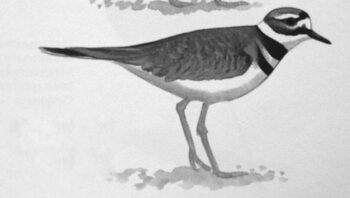
Photo from The Sibley Guide to Birds by David Allen Sibley
Ada Sheldon, on a Mound Prairie farm in Houston County, kept a large garden and raised chickens, geese, ducks and canaries as well as children, one of whom was son Sumner (born 1910), who would become a prominent area historian and columnist. “To be sure that she had enough to do, Mama kept about sixty swarms of bees,” quipped Sumner.
His mother, while an accomplished delegator of farm duties, did most of the bee work herself with some help from daughter Laura. At honey extracting time, daughter Lois was called to collaborate. That bee threesome could complete the job in about a week.
Mama’s bee yard was just a few rods east of the farmhouse. With that many busy buzzing bee bodies flying so near the house, someone was always being stung. “Mama paid no attention to bee stings.” It hurt Sumner, but he got to where he did not swell too badly. His father, however, was especially prone to swelling and never went near the bees. “But if there was one bee with a mad on, Dad was the one who got stung, and how he did swell!” A sting in the eyebrow caused the worst swelling, but especially painful was being stung behind the earlobe.
He understood how worker bees earned their name.” From maturity ’til death, they work during every minute of every good day. Most of them die afield, as their wings, worn, torn, can no longer carry them.” A few flowers pollinated plus a teaspoon of honey were the meager results of a full life.
During the summers of the first couple of decades of the 1900s, Reverend McKinney came from Caledonia to Hokah every other Sunday afternoon to conduct church services. As a boy, Sumner deemed “unthinkable” to be “dragged off to church on a summer afternoon when there was a ballgame in Carrigan’s pasture.”
After dinner on one of those weather-perfect Sunday afternoons, he was outside on a swing, hoping to be overlooked at church time. However, after his mother yelled out for him to come in and get ready for church, he was walking toward the house when he stepped on a bee. It was a direct hit between two toes, which quickly swelled “to the size of potatoes.” He hopped on one foot into the house and presented his predicament to his mother, “I can’t get a shoe on that foot.”
When she considered he might have intentionally stepped on that bee, he replied, “No, never thought of it.”
“You can’t go barefooted to church, so you stay home today.” When he asked if he could go to the ball game, she said they did not have time to take him there.
“I could walk.”
“Crippled like you are? All right, all right, we’re late now!”
He claimed to be a lifelong birdwatcher, mentioning wild birds not the barnyard fowl. While still farming as a senior citizen, he discovered about five killdeer nests each spring. It was often difficult to keep from destroying one, since they nested on the ground and the color of their eggs perfectly blended with the surroundings.
Unusually early in the spring of 1986, he and his tractor were surprised by a “pugnacious” killdeer hen near the cattle feed lot. He stopped immediately and carefully taking one step at a time, he found her nest and four eggs. While backing the tractor away from the nest, the airborne killdeer rooster screamed threats from above.
Weeks later, he was plowing nearby and was again confronted by a hen killdeer. Again, he was able to find a nest with the usual four eggs and once more the object of overhead intimidation from a rooster. He was sure he had disturbed the same parental pair with their second nest just across the fence from where they had raised their first brood. He had never seen other killdeer “so brave or foolhardy” to so vehemently engage something as large as a tractor.
In between those two aggressive encounters, a pair of killdeer parents and three or four chicks appeared in the steer feed lot. The fully-feathered but half-grown chicks could not fly but could run. Maybe, he surmised, that being near such large powerful animals gives tiny young birds a feeling of security. A few days later, there were only flying killdeer on site. One day later, the steers were alone again.
As protective as he was of the killdeer, Sumner by no means considered them to be songbirds. “They yell and scream all day and sometimes fly at night for no reason that I can see except to practice communal screeching.” He termed a killdeer’s yell to be “so loud, so raucous, so incessantly repetitive and tiresome” that it would be considered musical only by a teenager of the 1980s.
He was puzzled why some farmers, who being so close to nature, took no interest in wildlife. He was most adamant about protecting squirrels, which he considered essential to valuable walnut forests. “Old Mother Nature developed nut trees to feed her wild squirrels, who repay their debt to trees by planting their seed. It is a marvelous arrangement, and neither wild squirrels nor wild oak and walnut forests can survive without the other.”
Writing in 1986, he noted deer so plentiful that, possibly the most since the famous winter of 1857 when most deer, trapped in ice and snow, were clubbed to death by early settlers in Houston County. Although not especially interested in conserving a large deer population, he was reluctant to allow unrestricted deer hunting on his property “because of the particular interpretation some courts give to farmer’s liability.”
The quickest way to lose all hunting privileges on his land was to be known to be hunting squirrels. He chastised the Minnesota Department of Natural Resources (DNR) for saving peregrine falcons who feed on song birds while paying no attention to his “haranguing them about squirrels as potentially the most important wild animal in North America.”
Source: “Now and Then” newspaper columns by Sumner Sheldon, published April 3, July 10 and September 11, 1986 by the Houston Gazette and Country Journal
Leave a Reply