

Part one of a two-part series
Four years ago, for the 2021-2022 school year, wrestling for girls became a sanctioned high school sport in Minnesota. But about 160 years earlier, sometime about 1860, one female took part in possibly the first wrestling tussle in Houston County that included a female, surely the first one recorded in a history book. And that 19th century, two-combatant matchup warranted historical notoriety because it featured only one female.
A lumberman bragged about his strength and ability to fight. One day, someone offered him a wager that there was a “cottager’s wife” whom he couldn’t lick. The braggart accepted the wager. Guri Solberg, wife of Spring Grove farmer Elling Solberg, was described as “a giant of a woman, who in strength could measure up to the strongest men in the township.”
Guri also accepted the challenge and following a few moves, had the loudmouth man down on the ground more quickly than any expected. Witnesses roared with laughter at the humiliation of a braggart, who surely boasted no more around Spring Grove. This great grappling event was recorded on paper by historian/author O. S. Johnson.
Johnson related another story of immense strength. Knute Roverud, who had been a lumberjack in Norway, was known in Houston County for his ability to chop and process as many logs by himself as two other good lumberjacks combined. When he was at a local dancehall and a couple of liquored-up patrons decided to settle a dispute with fisticuffs, Knute had a simple solution. He would pick up a combatant in each hand and bang them them together a few times until their fighting fervor was sufficiently diminished for peace to be restored.
Johnson, accompanied by faithful, yellow-colored canine companion Fido, rode in his top buggy, pulled by his white horse to call on friends and neighbors throughout three Houston County townships: Spring Grove, Black Hammer and Wilmington plus a part of Caledonia. It was research for the farmer/part-time lumberjack, who had never lost his love for reading and also writing books. One of his six books, written in the Norwegian language, was “The First Norwegian Pioneer Story of Spring Grove and Vicinity,” published in 1920.
That was a half century after he, at age 27, and wife Marie Ringerud and all four children had emigrated from Norway to the Spring Grove area in 1870. He worked on a farm for the first two summers and cut logs in the winter in Northern Minnesota and Wisconsin. He finally purchased his own 160 acres in Wilmington Township.
Between 1840 and 1874, the average immigrant voyage from Norway to North America was 53 days. Depending on weather, the quickest reported crossing was 25 days, but it could be much, much longer. Gulbrand Nilson Myhra and Martha Ostensen, a young married couple endured a stormy passage that took about 77 days in 1854. The Ole Sagadalen family, who immigrated in 1847, spent about 98 days (more than three months) on the Atlantic before several weeks overland to Minnesota Territory.
Not everyone who boarded an emigration boat survived to disembark. Knud and Guri Roverud had eight children, one of whom died in Norway before two more died during their voyage and were buried at sea.
Many of the early immigrants, who came to the Spring Grove area, first spent time in Wisconsin among Norwegian settlers who had preceded them. Torger Johanneson Tendeland, who is recognized as the first Norwegian who made his home in Spring Grove Township, immigrated in 1949 and lived in Wisconsin until 1852, when he and his family left by wagon and oxen for Iowa. He then walked into Minnesota Territory to locate a site on which to settle.
After a few years residing at Rock Prairie, Wis., the aforementioned Sagadalen family loaded their belongings onto wagons, pulled by oxen westward to Spring Grove. Ole dug into a hillside a cellar, which served as a kitchen, living room and bedroom for two years.
Peter Johnson Lommen, one of the earliest pioneers, spent a year in Wisconsin before coming to Spring Grove Township. His son, John P. Lommen, was the first male child born to Norwegian parents in Minnesota.
Ole E. Stenerodden, a young blacksmith, realizing that economic prospects in Norway were poor, emigrated from Norway in 1851 at age 27. After two years in Wisconsin, he became a farmer and blacksmith a mile east of Spring Grove. By the 1870s, he was recognized as the wealthiest man in town.
Baard Quale experienced hard times after joining many Norwegian immigrant friends in Stoughton, Wisconsin. Prices for farm products were low, including 30 cents a bushel for wheat. It was difficult to find work and when he did, Baard earned only 25 cents a day. It doubled to 50 cents the second year, but on the farms, the work day was long and difficult. And many of his friends perished during a cholera epidemic.
In 1853, Norwegian immigrant Gjermund I. Lommen, a friend of the Quale family, left Stoughton for Minnesota Territory and promised to write Baard about prospects of earning a living there. After a few months, Lommen kept his promise, even walking 25 miles from Wilmington Township to the nearest post office in Brownsville and then trudging 25 miles back as well. In 1854, Baard and his family, joined Lommen in Wilmington.
However, pioneer life could be perilous in Minnesota, too. In the winter of 1856-57, the amount of snow prevented trips to the mill. Baard’s wife Anna had to grind corn and wheat in her coffee grinder to come up with some kind of flour to make bread. That and boiled hulled grain (groats) comprised their diets for for weeks. They persevered and 22 years later were considered well-to-do.
Winter claimed the life of Ole Kolberg, who sometime after arriving in 1853, died in an accident, freezing to death on the road between Spring Grove and Caledonia. To be continued …
Sources: The Pioneer Story of Spring Grove and the Surrounding Area, Minnesota, by. O. S. Johnson, 1920, with published notes of grandson Ove Guberud. Soil, Timber and a Spring, by Jane Briggs Palen, 1991
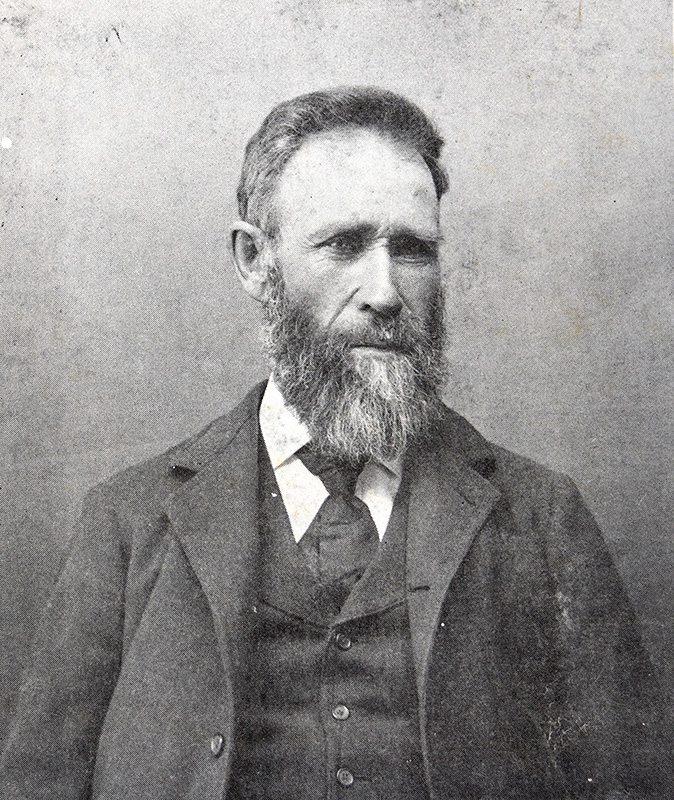
Photo submitted
Beth Schwartz says
Thank you the story. O.s. Johnson is my 2x great grandfather, his daughter bolethe is my great grandma.
Mark Reps says
Great story.