
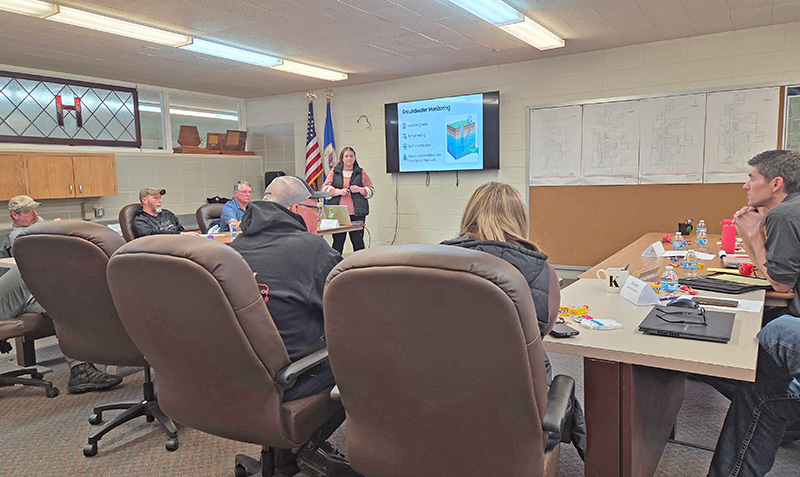
Photo by Hannah Wingert
Members of the Harmony City Council, the EDA, and the Planning and Zoning Commission met on March 18 for another joint planning session to continue discussing the creation of a city ordinance to govern a data center if one were built in Harmony. As of now, there is no development agreement or specific company that is planning to build a data center in Harmony, but there are multiple companies interested due to the fact that MiEnergy and Dairyland Power Cooperative have excess energy available. The joint meetings between the three groups ensures that everyone is on the same page throughout the process of drafting the ordinance and for full transparency to the public. At each of the meetings, the public is welcome to ask questions and give input. Currently, the first draft of the ordinance is in its end stages.
The various sizes of data centers are edge, medium, large, or hyperscale. Hyperscale has already been eliminated as an option that would be allowed in Harmony. Sixty acres of farmland near Dairyland Power Cooperative have been annexed into the city as a site for a potential data center. A discussion of whether to create an Industrial Zone, an Industrial Technology Zone or a conditional use permit was held. The creation of an Industrial Technology Zone was agreed upon.
The water use policy was addressed next. It had previously been decided that no water cooling system will be allowed, even on a continuous loop. The only water usage allowed for a data center will be for bathrooms, sinks, and cleaning. The group decided to require quarterly reporting for water usage from the data center in the ordinance. A limit to trigger a review by the city will be clarified later after city staff can be consulted on typical business use. Groundwater monitoring was also discussed and a spill response plan was added to the ordinance.
The proposed limit for noise standards was 60 dBA. Several members of the public felt that it should be lower, but after discussion, the group agreed on leaving it as 60 dBA.
Options for setbacks and buffers were reviewed next. It was decided to have the minimum setback at 500 feet from a residential area with a 300-feet minimum with a chance to have it increased on a case-by-case basis.
The data center would be buying energy directly from MiEnergy and not from the city. That means that the city would not have to purchase land, put a line in, etc., but instead will receive a franchise fee. Several community members voiced concerns about increased utility costs. Katrina Hurley, EDA coordinator for St. Charles, Minn., and serving as the facilitator of the data center ordinance drafting discussion meetings in Harmony, said that since the data center would be buying energy directly from MiEnergy, costs would not increase for Harmony residents. However with an increasing number of data centers being built in Minnesota overall, stretching energy grids, rates are going up all over. EDA member Stuart Morem noted that the data center would make MiEnergy more money which could actually benefit Harmony’s infrastructure. It was decided to include a requirement for a reporting system for peak demand levels in the ordinance. Generator testing hours will be kept to the state standard.
It was decided to set the megawatt usage limit to 40 and then address it case-by-case after that. Dark sky lighting was also approved for the ordinance with a one-foot candle limit.
Options for environmental reviews were discussed. An Environmental Assessment Worksheet, or EAW, would be a project specific report done by the developer while an Alternative Urban Areawide Review, or AUAR, would be more of an area-wide planning tool which would be done by the city before development. Another option would be to do an Environmental Impact Study, or EIS. It was decided that an EIS will be required by the ordinance.
Decommissioning options were reviewed to ensure that the city is not left with abandoned land if the developer were to leave suddenly. A bond or escrow would be used to provide financial assurance for land restoration and could be updated every five years due to inflation. City Attorney Greg Schieber noted that as the city would not own the land, it could be considered trespassing for the city to enter it for remediation. He suggested amending the city’s nuisance ordinance to include abandoned shipping containers which could give the city more leverage. Harmony CEDA coordinator Chris Hahn recommended talking to MiEnergy and Dairyland about their procedures for abandonment. It was decided that the amount would be set on a case-by-case basis based on how much it would cost to decommission the site with reviews every five years.
Anonymous says
Please say NO to the data center. The harmful effects on animals, humans and environment are hidden from the public. Water usage is also a hidden from the public.
Anonymous says
Please say no to a Dara center.. I can’t think anything worse for the entire community,