

Cattle drives in Houston County, Minnesota? Yes, but it was nothing the bovines expected or enjoyed. Cattle drives were featured in many western movies, but likely no film depicted cattle drives to La Crosse. In the late 1800s, farmers were their own butchers for family and nearby neighbors. And there was also a commercial market at packing houses, especially for hogs and cattle.
Hogs were rarely sold alive, mostly marketed during winter, when butchered pork could be transported to market without spoilage. Cattle were sold alive during warmer months, provided they could be driven on foot to market. Each butcher in a city had teams of horses and wagons, with which they searched the countryside for cattle, calves, hogs, sheep and poultry. For cattle, they preferred to purchase enough in an area for the farmers to drive their market cattle on foot to town, in this case to La Crosse.
Houston County cattle drives did not present the same problems as did the cattle drives on the western plains, which traversed hundreds of miles and consumed three to five months. But there were problems nonetheless. The cattle were not used to being away from home and according to historian, W. J. Langen, “quickly sensed that something was wrong.” Each herd had a bell cow, and the farmer often removed the bell and rang it himself while heading in the direction he wished the cattle to follow.
To prevent the cattle from running away, some farmers hung around the cow’s neck a chain from which a three-foot pole dragged between the animal’s front legs. Or they might tie a board to the cow’s horns to cover its eyes enough to make escaping difficult.
Or they might tie a rope to one horn and a front foot. As a boy, Langen witnessed a steer tied in this manner almost drown in the Root River. “The quick action of a man who jumped into the river and cut the rope saved the steer.”
Cows were sometimes tied behind a wagon, which worked well for cattle that were accustomed to being tied. “But others would sometimes put on their brakes and slide along behind the wagon like a carpenter’s saw horse.”
Writing as a senior citizen, Langen described innovation when in later years, farmers made cattle racks for their wagons in order to haul cows to market. “I took measurements of such a rack and made one for my own use. After that, our stock went to market on wheels.”
Later, farmers used trucks to haul stock to market or phoned the stockyard to have the stock picked up. By the time of his writing in 1949, Langen informed that local stock was no longer butchered for commercial purposes, but only at home for family use.
However, during the pioneer era of the late 1800s, without refrigeration and in between warm-weather cattle drives, beef was butchered on the farm during winter and sold mostly in quarters to private parties.
But winter was major market time for pork. While cattle were being herded reluctantly to market, hogs were being fattened to be butchered and sold when Mother Nature provided refrigeration. As Langen described it, the farmer’s equipment “was simple. Two poles, eight to ten feet in height, each with a crotch on top, were set up side by side. A pole held the pig after it was killed.”
Carcasses were scalded to soften hair follicles so that the hair might more easily be removed. Water was heated in a large iron kettle and then poured into a barrel or large trough. The carcass was lowered by a pole, balancing on a post, into the water.
When neighbors were butchering a good number of hogs for market, it was a neighborhood family affair. Each man had his specified task, one heating the water, another doing the killing, others scalding and shaving the pigs. “Then the intestines were removed, placed in a wash tub and promptly carried into the house where ladies removed the lard.” Everybody was involved.
“The horseplay really started when the boys began to blow up the bladders for balloons. However, they never burst as rubber balloons do, and many a bladder would up being somebody’s tobacco pouch.”
The work was followed by a large meal and an evening of socializing. Meanwhile, the carcasses were hung up outside where they would freeze solid overnight. Dogs were tied up nearby as guard dogs in case roaming dogs might be attracted to a midnight meat feast.
In the morning, the carcasses were hauled into town, sometimes “loaded up in wood racks like cord wood.” Some would be sold to private parties, but most were destined for packinghouses, which operated during the winter. Butchers there would process the pork into hams, shoulder hams, bacon, sausage meat and lard. Some meat was cured, always with smoke from hickory wood.
Because spoilage accompanied warm weather, “heads and feet sold cheaply.” Langen recalled a large head brought 25 cents and feet a penny each. “Hog prices at the time were three and half to five cents per pound.”
For the family table on the farm, hogs were also butchered during the summer. Bacon and hams were cured in brine and smoked. Lard was rendered. Sausage meat was smoked or left in the brine. “Some cuts were fried and put down in their own lard.“
Major change came with refrigeration. Farmers could rent locker space and take livestock in a truck to the plant, where it would be killed, butchered and frozen there. Later, with a deep freezer at home, all meat preparation took place on the farm.
For a variety of entrees, pioneers were often hunters and fishermen. Aa a boy, Langen was taught to fashion a trap for rabbits searching for food in the snow. After he killed, skinned and cleaned the rabbits, his mother put them in a cellar crock marinated in brine of salt, pepper and vinegar. This was called hasenpfeffer (“peppered hare” translated from German).
Source: History of Early Days of Hokah, Minn. by W. J. Langen, 1949.
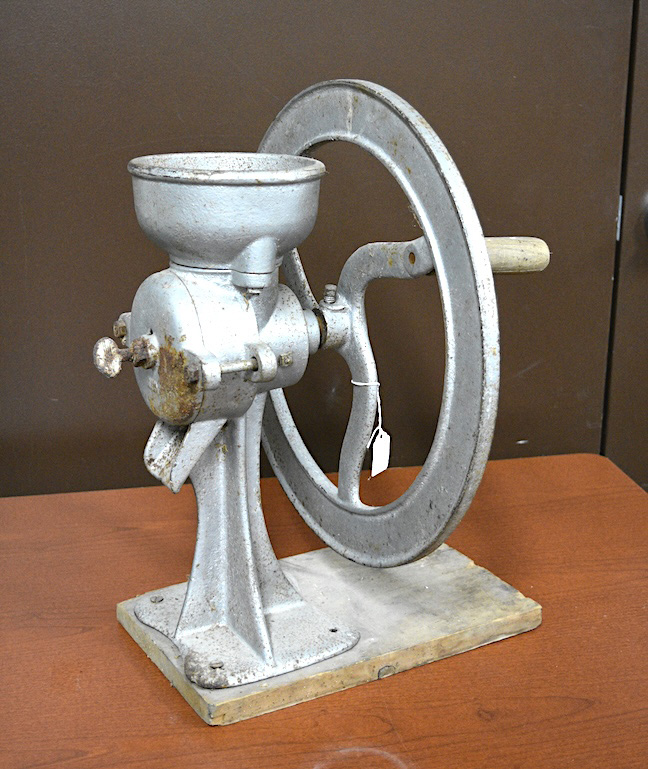
Photo by Lee Epps, courtesy of the
Houston County Historical Society