
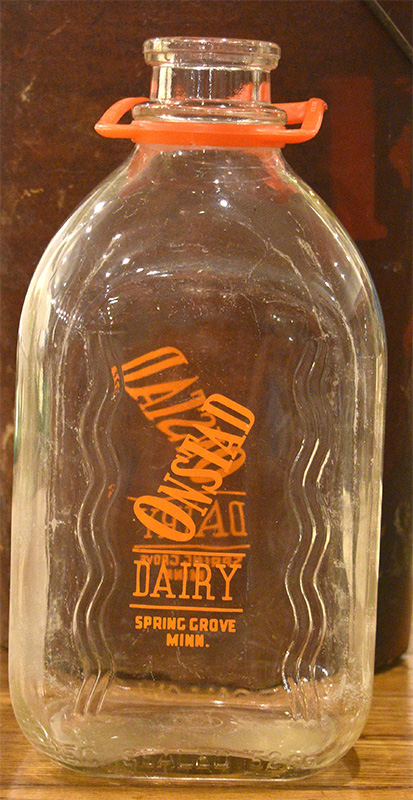
Photo by Lee Epps, courtesy of the Houston County Historical Society
The milkman was not a man. The milk delivery “person” was actually a milk maiden. And her helpers were her two school-aged daughters. In the early 1940s, during World War II, Eunice “Granny” Murray delivered milk door to door in Hokah, Houston County. Her husband worked full time in La Crosse, so milk delivery was strictly a female enterprise.
Arising at 4 a.m., Eunice and one daughter, either Aggie or Marian, drove to the Fairbanks farm in the nearby area known as Mound Prairie.
The first task was the bottling process. The milk was in a large vat, around and below, which the empty bottles waited to be filled. Each bottle would be filled with milk when Eunice pulled a handle above it. As the bottles came around, she would pull another handle, and a cap was pressed onto the bottle.
The bottles would then be placed into wire crates, each of which would hold a dozen bottles. Next, the cream was bottled into half-pint bottles. By 6 a.m., mother and young daughter were heading back to town in their truck filled with crates of quarts, pints and half pints of milk and cream.
Their route began at the west end of Hokah as they stopped at each house. Mother and daughter each toted a wire carrier that held six bottles as they approached each door, where customers had placed the number of empty bottles they wished to be replaced with full bottles.
Customers had previously purchased a book of tickets, such as 11 cents for a quart. They placed a ticket into each empty bottle. Or they might place coins in the bottles instead of a ticket.
When they arrived at their own home, the daughter would be dropped off to get ready for school and youngest 5-year-old daughter Ella Mae would arise to join her mother on the route. Ella Mae was left in he truck to stay warm while her mother now made all of the deliveries by herself. In the summer, the daughters helped all the way around town and also helped wash the bottles back at the farm.
There were two ladies on the route, the Mumpys, that might leave a note, “Please do not leave milk; the cat left home.” Maybe a week later, they would flag Eunice down to say, “The cat is back; leave milk.”
One family with many children did not always have milk money, so they sent one of the kids out with the bottles. Eunice could not refuse them, so she would leave milk for them for a few days until they were able to pay again.
Grandma Morman invited the daughters inside to warm up by the oven door on cold winter days. Another lady would often complain that she was receiving sour milk, but she never had any milk to return. Finally, after Eunice refused to replace the alleged sour milk with fresh milk, there were never any more issues with sour milk.
There was a house on a hillside across the lake with several flights of wooden steps up to the dwelling. One day when Aggie was halfway up the steps, she noticed there was a note in the bottle. Thinking that they wanted more than the usual one bottle, she descended back to the truck, grabbed more milk and headed back up all the steps. Once at the top, she discovered the note was frozen into the bottle. After a while, she got it out. It read, “Please excuse the dirty bottle” – ugh!
After all the deliveries, Eunice returned to the farm, unloaded the empty bottles and re-washed them. There was a rotating electric brush, which thoroughly washed the inside of each bottle. One day, there was bottle with a crack, which Eunice did not notice when she put the bottle on the brush. The bottle broke and put a three-inch gash in her hand. A trip to the hospital and stitches were required.
Another day, their vehicle broke down on the way home. While walking along Highway 16, they came to an encampment of gypsies. Fearing there might be a kidnapping attempt, Eunice and her daughters hurried past them without uttering a word.
Eunice would not retire as a milk person until expecting a fourth child.
Lee Epps and the Milkman
A decade later, also in Houston — but the city of Houston, Texas, rather than Houston County, Minnesota, milk was also delivered door to door, and my mother placed our empty bottles on the kitchen porch.
I do not recall how often it was delivered or how much it cost. I surely knew that milk came from a cow even though I had never actually encountered a live bovine. As a grade school lad, I knew milk came “to me” from the milkman and his milk truck. He drove a truck of similar design as today’s UPS trucks.
I also do not recall whether it was a rare privilege that was offered by our milkman or was the result of a young boy pleading for a favor. As I remember, it was against dairy policy, but what a treat it was to ride around the block in the milk truck, standing room only.
It must have been during the summer when there was no school. I do not know if my milkman had any other, surely unauthorized, passengers in other neighborhoods. But in my postwar neighborhood on Arnold Street, which was heavily populated with other children about my age, I do not remember anyone else getting to ride around the block with the milkman. We all drank milk, but a brief ride on the milk truck was something special. I was not dropped off back at my house and surely had to walk home around the corner — a small inconvenience for a huge favor.
Source: Story of Hokah from Aggie’s View, by Aggie Tippery, 2001.
Leave a Reply