
 By Lee Epps
It was not airmail, but the incoming mailbag was certainly airborne for a few seconds as it was tossed off a moving train to an awaiting Isaac Holmes. The mail moved by rail, but this train did not stop at San Jacinto, Minnesota, where the post office hired Holmes to meet the train where he could.
Holmes, who resided near the present-day Valley High Golf Course, would once a week walk to the postmaster’s house, which was also the post office, to pick up the outgoing mail and walk back past his house through what was known as the Gap downhill and north a fourth of a mile to the railroad tracks.
He would then wait on the train and somehow get the outgoing mail onto the moving train and retrieve the incoming mail after it was tossed from the train. He would then trudge back uphill through the Gap to the postmaster’s house.
This was the late 1860s, a decade and a half after white settlers had first arrived in southeast Minnesota in the early 1850s. Their only connection to the greater world was the United States Mail. The first area post office was established in 1852 at Brownsville. Mail could travel by train to a depot on the Mississippi River and then be transported by steamboats upstream to Brownsville, Minnesota Territory but only during weather warm enough for the Mississippi to be free of ice.
Before train tracks extended west of the Mississippi, mail was carried most efficiently by stagecoach. But stagecoaches did not go everywhere, such as Eitzen, where some early settlers had to travel, some it was said on foot, 20 miles one way to Brownsville to get their mail or post a letter.
Mail service would expand. In 1855 and 1856, there were 18 post offices established in what would become Houston County, followed by a half dozen more in 1857 and 1858, the year of statehood. Existence could be fleeting with 10 being discontinued or relocated before 1868.
With most settlers being farmers, there were more post offices than towns (which were called villages in that era). A post office may have been inside a small store or a private residence, and it was most convenient if it was on a stagecoach route like the famous Lorette House. The era of stagecoaches in southeast Minnesota lasted about three decades – from 1949 through 1879 – before being replaced by railways, a faster and more comfortable means of mail delivery and passenger travel.
Near present-day Houston, there was a United States post office at the proposed village of Looneyville in October 1855, exactly eight months before the Houston Post Office. On May 22, 1856, postal service was established at both Houston and the proposed village of San Jacinto, the latter east of Houston and northwest of Hokah.
San Jacinto and Looneyville were among many proposed villages that were possibly platted but never populated.
Photo compliments of the Houston County Historical Society
In 1855, Looneyville did have a store, which was said to have been so small that all the merchandise could have been removed in a wheelbarrow. Postmaster Isaac Thompson kept the mail in a dresser drawer until a recipient arrived.
The Houston post office survived because the railroad came south of the Root River rather than north of the waterway through Looneyville and the proposed Winfield or St. Lawrence.
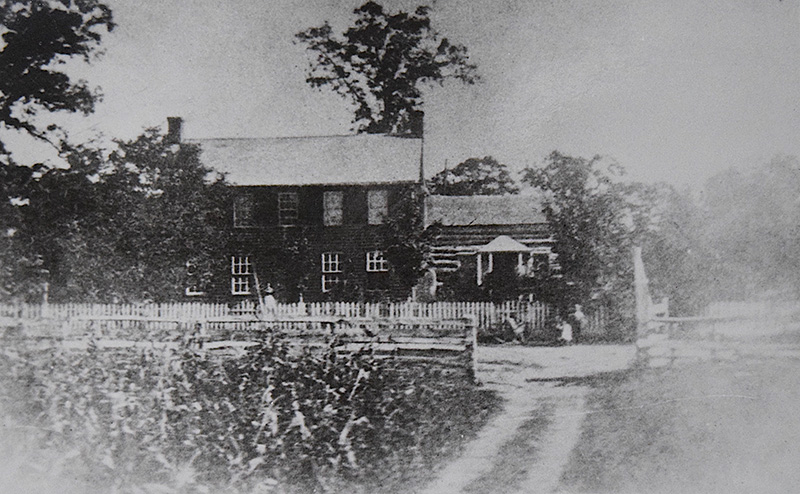
The first post office in San Jacinto was in the house of the first postmaster George Canon, a well-respected citizen whose residence was a convenient traffic location. He earned a living by providing hay and fodder within a fenced paddock and feed trough where travelers and especially teamsters hauling wheat and pork to La Crosse could stop to feed, water and rest their oxen and horses.
Before his death, Canon deputized Dr. Giles James Sheldon as postmaster in 1864. Formally appointed postmaster in February 1865, Sheldon wrote to the Postmaster General that the San Jacinto Post Office was almost out of stamps, requesting 300 one-cent stamps, 200 two-cent stamps and 50 ten-cent stamps. The rural Sheldon home became the new post office.
There were some who came to the San Jacinto post office to have a letter written before posting it. Postmaster Sheldon’s oldest daughter, Elizabeth, would write their letters after taking pains to get the details correct.
During Sheldon’s first two years as postmaster at San Jacinto, there was no regular mail delivery between post offices. According to his grandson, Sumner Sheldon, “Outgoing mail was entrusted to almost any person, known to the postmaster as worthy of trust, who was en route to a town with an important post office.” Dr. Sheldon’s diary mentions neighbors who brought letters to him from the Brownsville post office.
“In early years, practically all mail for Houston County and the Root River Valley was delivered to Brownsville and sent on to the small post offices by whomever the Brownsville postmaster deemed competent and dependable.”
A February 11, 1867, letter from the Postmaster General authorized Postmaster Sheldon “to employ a suitable person of proper age, to act as messenger in the conveyance of mails once a week, each way, between your office and the nearest railroad station, at a cost not to exceed twenty-six dollars ($26.00) per annum.”
Dr. Sheldon’s records show the aforementioned Isaac Holmes being paid $39.50 for 18 months of mail messenger service, April 4, 1867, to October 7, 1868. By that time, the railroad had been completed though Mound Prairie Township and just west of Houston to Cushon’s Peak. However, it did not stop at San Jacinto.
With that 1868 payment, Holmes retired. With no other replacements available, the assignment went to Sheldon’s 13- and 14 year-old sons. However, they could not be paid, since the Postmaster General had informed, “No member of the postmaster’s family or his household can be paid to act as mail messengers.”
With the establishment of the Mound Prairie Post Office at Eberhard’s Store, the San Jacinto and Loretto post offices were closed on January 16, 1871.
Sources: “Now and Then” columns by Sumner Sheldon in the Houston Gazette and Country Journal, 1988; Historical Notes of Interest, by Mason Witt, 1974.
Leave a Reply