
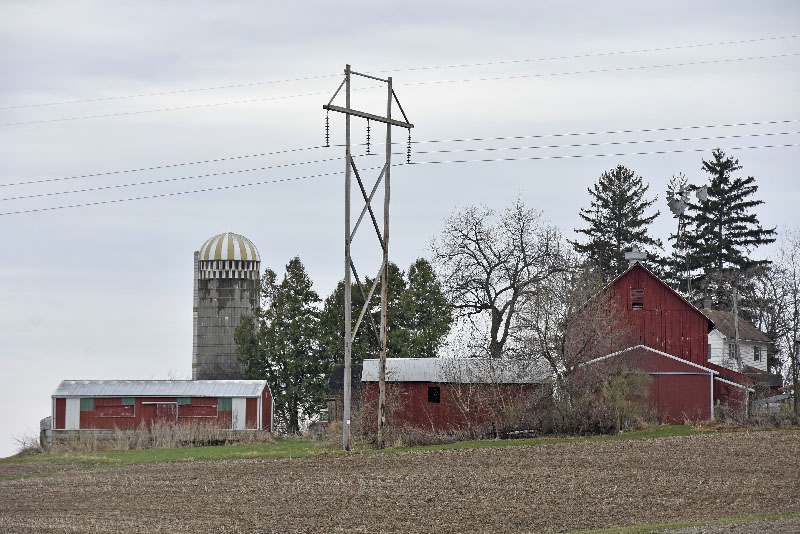
Photo by Charlene Corson Selbee
The proposed MariBell Transmission Project has become a major talking point for communities in Fillmore and Houston counties as utilities seek approval for a high-voltage line that developers say is needed to strengthen the regional electric grid. Opponents say the project could permanently alter farmland, landscapes, and rural communities and affect the health of landowners.
The Midcontinent Independent System Operator (MISO) is poised to “build a backbone to transport energy across the Midwest.”
The MariBell project is a segment of the Gopher-to-Badger Link, a proposed transmission corridor running from Minnesota toward Wisconsin. In southeastern Minnesota, the MariBell segment is proposed to run through Fillmore and Houston counties.
Xcel Energy will develop 35 miles of a new single-circuit 765 kV transmission line segment from north Rochester to Marion, Minnesota, while Dairyland Power Cooperative and GridLiance Heartland LLC will develop the line from Marion, Minnesota, through Fillmore and Houston counties to Bell Center, Wisconsin.
The project has drawn attention in part because of its size. The MariBell line would replace the current 161 kV line with a 765 kV double-circuit transmission line. It would be among the largest alternating-current voltages currently used in the United States and would require tall steel lattice structures reportedly ranging from about 150 to 199 feet, along with a right-of-way that could expand to approximately 250 feet wide.
Benefits
Jessica Hewitt, senior director of transmission execution for GridLiance Heartland, said the project could provide several benefits.
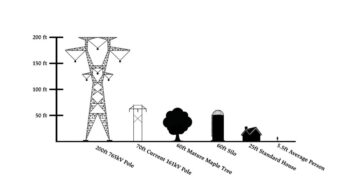
Image submitted
Hewitt said using Dairyland’s existing 161-kilovolt corridor could reduce impacts on landowners and the environment. She also said the project could improve grid reliability, strengthen resiliency by replacing aging infrastructure, generate revenue in Minnesota and Wisconsin, provide access to lower-cost generation, and create construction jobs that would support local hotels, restaurants, gas stations, and other businesses.
Eric Jacobson, stakeholder engagement and key projects manager for Dairyland Power Cooperative in La Crosse said the MariBell segment is one part of a larger MISO-identified project intended to address projected electricity growth over the next 20 to 40 years in homes, manufacturing, and small businesses. He said the line is designed to relieve congestion and serve long-term load growth, and that rebuilding within Dairyland’s existing corridor is a key advantage.
As reported by the Center for Rural Affairs, “Nationwide, electric demand is estimated to increase by 15.8% by 2029,” according to Grid Strategies.
Cora Hoffer with the Center for Rural Affairs reported on March 10, 2026, that the line could generate about $375 million in local and state property taxes in Minnesota and more than $200 million in construction and operating activity.
Jacobson confirmed that substations along the route would allow the project to benefit the broader Midwest.
Concerns
County boards, city councils, and individuls along the proposed route have raised concerns in letters and public comments submitted to the Public Utilities Commission (PUC).
The City of Spring Grove, for example, has cited concerns involving property values, agricultural land use, drainage systems, future municipal growth, infrastructure corridors, environmental resources, scenic landscapes, public health and safety, emergency services coordination, the city’s tax base, and economic development prospects.
Houston County also opposed the proposed Gopher-to-Badger Link in Resolution No. 26-98, approved at the February 17, 2025, commission meeting. The resolution cited concerns tied to land use, agriculture, natural resources, scenic landscapes, public health, property values, tourism, construction impacts, eminent domain, and whether the project would provide a direct benefit to county residents.
NO765MN, an ad hoc landowners’ coalition, emphasized three reasons it believes the line is not needed on its promotional material: electricity demand has flatlined or even declined; the line would not provide power to the region, but rather move power from the west to the east; and the line would provide power for data centers like those being proposed across Minnesota and nationwide.
Opponents have also questioned the project’s cost and estimate it at $979 million to $1.273 billion (2024 dollars), along with annual maintenance costs of approximately $3,200 to $4,500 per mile which would be paid for by Minnesota ratepayers.
Additional concerns raised in public conversations include rural landscape impacts, loss of generational farmland through easements or eminent domain, decreased property values, habitat disruption, water-table risks, health impacts, and questions about whether the line would meet Minnesota power demand or primarily move electricity through the region.
The Public Utilities Commission (PUC) will ultimately decide whether the project receives a Certificate of Need and a Route Permit. Residents who support the project, oppose it, or still have questions have an opportunity to make their voices heard through the PUC’s e-Dockets process. Search for docket number 25-121.
Leave a Reply