

They have been politely called “speculators” or “real estate agents,” and more harshly, “shysters.” But according to Houston County historian Sumner Sheldon, the term used by the early settlers of the Minnesota frontier was “land sharks.”
These unpopular, often unscrupulous land sharks purchased land, not to farm but only to sell for higher prices. A rumor of a railroad coming raised the price even more.
Before the 1850s, most white people in Minnesota were either fur traders, loggers or government agents. This changed soon after Minnesota officially became a territory in 1849. After two treaties, Traverse des Sioux and Mendota, were signed in 1851, the United States government acquired millions of ares of land from the Dakota people. This resulted in white settlers from both Europe and the eastern United States swarming into Minnesota Territory to purchase land and start farms. Suddenly, land became more valuable and therefore more profitable than furs or timber.
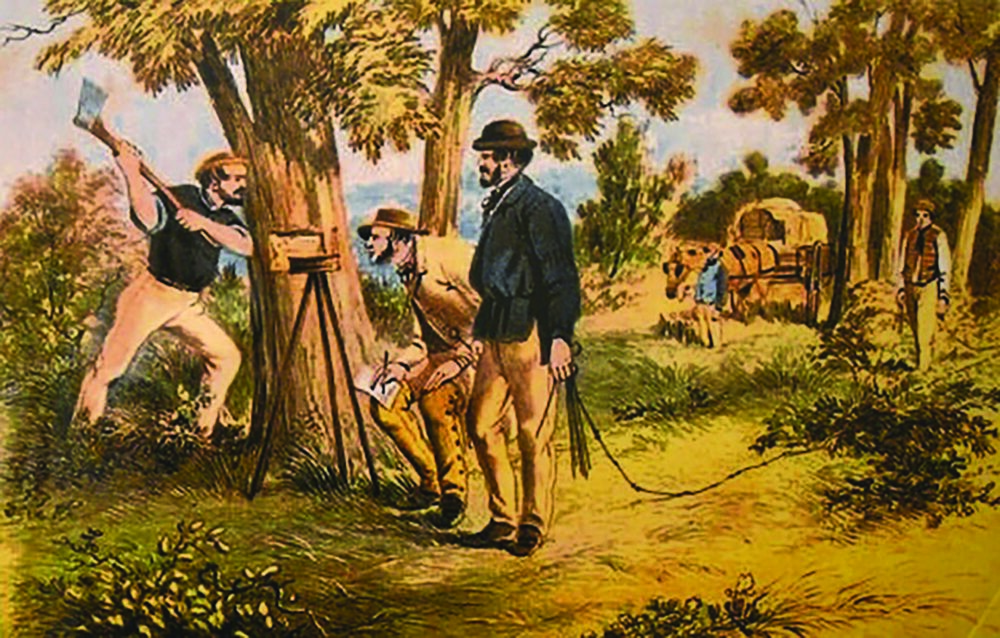
Farmers could buy plots of land for as little as $1.25 per acre, but speculators (land sharks) rushed in to purchase plots at the same price as soon as they were available and quickly raise the price for resale. Settlers could not legally buy land until it had been surveyed by the United States Land Office. Therefore, most early arrivals were “squatters.” They came so quickly and in such large numbers that the land office could not keep up.
Much of Houston county was “staked out” with stakes by squatters before the government survey established section and township lines. Then land could be officially “claimed” or officially entered into the government records. There must have been a lot of adjusting of claims to fit the legal survey, according to Sheldon. “But somehow it was done and without too much friction. Land was so plentiful and so cheap, it really wasn’t worth quarreling over. Anyone who was dissatisfied ‘pulled up stakes’ and went further west.”
Congress granted preemption rights to squatters, promising that when their land was surveyed, they would get the first chance to buy it. But so clumsy was the administration that squatters were always in fear of losing their land to speculators. For instance, land might be opened for sale only to be put on hold for months. Settlers became embittered by the United States land policy, which they believed did not adequately protect them from speculators.
Photo courtesy of Houston County Historical Society
The early Houston County land office was in riverside Brownsville. As soon as speculators crossed into Minnesota Territory on a Mississippi River steamboat, they could enter the land office and purchase land which they had not visited. Most speculators never saw land before they bought it, hoping by the law of averages that they owned enough desirable property to turn a profit.
Land was not taxed until it was legally owned. So, numerous early settlers never intended to file and enter a claim, just live on the land, tax-free, until someone did claim it and actually pay for it. Some squatters were able to live on land for a year or two or even as many as 10 years without paying anything to anyone.
In addition to land sharks, there was also the possibility and fear of “claim jumping,” when someone intentionally filed a claim on land that had been staked out by someone else. Sheldon told about his great grandfather, Thomas Fairbanks, who had given up on finding land in Illinois, which was either already owned by farmers or offered for sale by speculators at inflated prices, which he either could not pay or would not pay.
While living in McGregor, Iowa, he worked for two winters on a crew that harvested oak and walnut logs in the Root River Valley in Minnesota Territory. While working there during the winter of 1853-54, Fairbanks found valley land he wanted, 240 acres west of what is now Valley View Country Club. He staked his claim and while driving his oxen back to McGregor, marked the return trail.
The following summer, the Fairbanks family, with help from Tom’s brother, a Mississippi riverboat pilot, crossed the Upper Iowa River and moved onto his claim with a few cattle, a few sheep and enough lumber and shingles to roof a small log house.
Having finally found and settled on land he liked and intended to purchase, Fairbanks was determined not to lose it to a claim jumper. On his first visit to the Brownsville Land Office, he encountered one of his neighbors. Although described as “a quiet and very polite man,” Fairbanks approached the neighbor and advised, “Sir, if you try to file on my claim, I will knock you down.”
Sheldon also repeated an incident of unique claim-jumping, told by his father about a family of five brothers, who desired the acreage of their five farms to be adjoining. But there was a claim staked by another man that prevented their plan. He refused to move, and the five brothers refused to pay his for his claim.
The matter was eventually resolved. During Christmas and New Year revelry, the five brothers found the obstinate neighbor on the ice of the Root River. After chopping a hole in the ice, the five brothers gave their neighbor a choice between abandoning his claim or being dropped into the river. Sheldon summarized, “Being more prudent than one would expect of a man who thought he could live where he wasn’t wanted, he agreed to move, ‘come spring as soon as the grass is green.”
This chaotic era of land speculation in Minnesota was aggravating but did not last long. The California Gold Rush, which had increased the nation’s money supply, ended in 1855. Easily-acquired credit for speculators tightened. The European grain shortage, which had boosted prices for American farm produce, ended in 1856. Major eastern financial institutions failed, which brought on the Panic of 1857. Land values dropped, banks closed and speculators lost their fortunes. Many Minnesotans became deep in debt, many of whom left in search for greener financial pastures.
Sources; “Now and Then” newspaper columns by Sumner Sheldon, published by the Houston Gazette and Country Journal; “Land Speculation, 1854-1857,” by Hannah Dyson as published by the Minnesota Historical Society in MNOPEDIA
Leave a Reply