
Photo submitted
Efforts to build a bike trail from Preston to Forestville State Park failed to go forward over two decades ago due, in part, to an inability to acquire needed right-of-way across private property. Progress toward that goal is being made over the past couple of years by individuals that believe in and are dedicated to that goal.
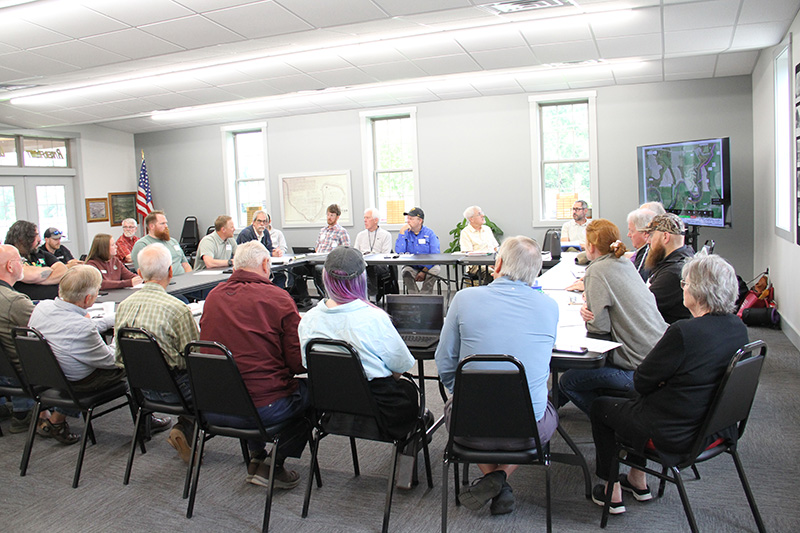
The Forestville Trail and River Committee last met in June. This committee is led by Jon DeVries. At the June meeting mayors of Preston, Lanesboro and Harmony were present along with community members from the three trail towns to see a presentation by Jon Hendrickson, engineer for the DNR Parks & Trail Division. Hendrickson proposed a trail route to Carimona that he felt met necessary design requirements. Partners in the effort to extend the trail include the Preston Historical Society, community leaders, Minnesota Historical Society, DNR, Forestville State Park, and the University of Minnesota team which includes Research Scientist Dan Handeen and Andi Sutton, Southeast Regional Sustainable Development Partnership.
Plans to go forward two decades ago were blocked due to the fact that needed easements could not be acquired. The older bike trails in the region followed old railroad lines. Newer trails and proposed trails do not follow rail lines and need the cooperation of property owners. The new trails will need to comply with the Americans with Disabilities Act (ADA) standards requiring grades with less than a 5% slope. DeVries explained the state has since passed legislation that forbids using eminent domain for a recreational purpose. He maintained they will work to gain the voluntary participation of landowners; eminent domain will not be used.
Minnesota lawmakers transferred $4 million to another project from an earlier $6 million legislative appropriation for the Preston to Carimona segment of the trail, because the funds could not be used within a required timeframe. The transferred funds in the amount of $4 million were used to complete the Harmony Stateline Trail to the Iowa border which was recently officially opened and for a spur to Niagara Cave. About $2 million of that earlier legislative appropriation is being used, working with the DNR, for engineering and final design and some land acquisition for a bike trail from Preston to Carimona. Another $2 million allocated by the legislature in 2026 will go toward the construction of a trail to Carimona. That $2 million was part of $4 million sponsored by Representative Greg Davids; $2 million for the trail and $2 million for restoration of the Historic Forestville Bridge. More funding will be needed to complete construction of a trail to Carimona.
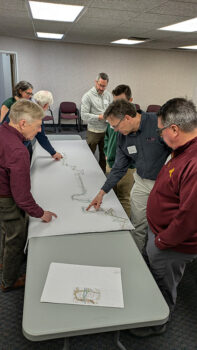
Photo submitted
Previous easements with property owners for the trail from Preston to Carimona remain in effect. However, because of steep slopes requiring wider curves and river buffers there will need to be adjustments to some of the easements to be compliant with newer standards. Committee member Joel Mielke and a promoter of conservation acknowledged they are in a holding pattern waiting for the DNR’s proposed route; once a proposed route is determined, they will know which landowners to contact. The change in standards will likely require the involvement of some new landowners along with those with existing easements.
DeVries said in the coming weeks they will be reaching out to landowners individually who will be affected by needed route adjustments, updating them to bring them into the conversation, and to facilitate next steps with DNR planners. The design for the trail to Carimona has not been finalized and can’t be until necessary land is acquired; an estimated 11 additional acres may be needed for route adjustments to meet new standards. Three trail routes are being considered; the final route could be a combination of various alternative routes dependent, in part, on input from the landowners. The most likely trail route would require five bridges. The paved trail is to be 10 feet wide. Engineers designing the trail consider the impact the trail and the space on each side of the trail will have on the landscape beyond the trail. The design allows for adequate sight distance for riders going the maximum speed of 20 mph. Design planners also consider how to best provide the public with an opportunity to view special scenic landscapes along the trail.
The University of Minnesota program, Empowering Small Minnesota Communities (ESMC), partners with Root River communities to help provide sustainable bike trails. ESMC has been working with the three-community committee since early 2025. Extending the trail first to Carimona and then on to Forestville State Park is expected to be a benefit to each of the three communities. ESMC works to solve design difficulties, designing safe ADA compliant trails over steep slopes and river buffers. There is an effort to improve the environment, along with the construction of the trail, protecting the scenic areas the trail crosses through. Sheila Craig, president of the Preston Historical Society, noted ESMC is looking at the ecological aspects of the river, as well. Partnering with Preston, Lanesboro and Harmony, the UMN ESMC program is designing local trail and river ecology projects to reduce erosion and provide bank stabilization to improve river stability. A group of Fillmore County water experts and advocates are developing a strategy for engaging with the Root River ecosystem investment needs to make ecological and river improvements. Local businessman Mel Hayner, owner of Driftless Fly Fishing Company in Preston, believes the extension of the trail will be great for the city of Preston, “a boom to the town.” He explained river improvement projects can improve both habitat and water quality.
Leave a Reply