
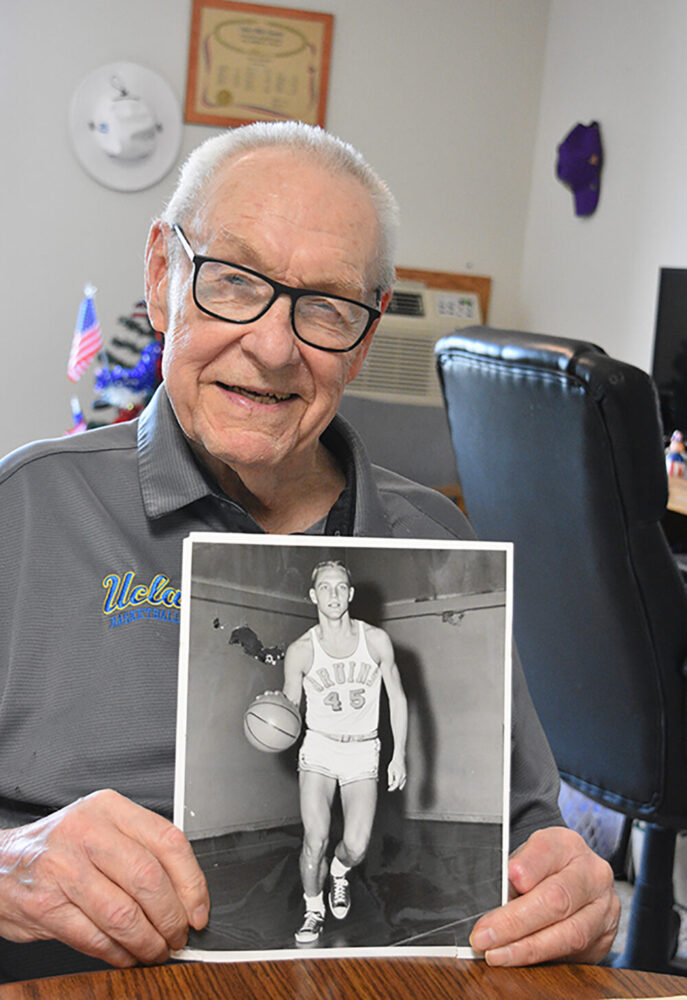
Photo by Lee Epps
He is arguably the most celebrated college athlete from Houston County, an All-American who helped lay the groundwork for what became the most successful Division I college basketball program in the nation. John Green began his basketball career at Houston, Minnesota, long before being pictured on the cover of Sports illustrated on the way to March Madness, playing a leadership role for UCLA (University of California at Los Angeles) in the 1962 NCAA national semi-finals.
Green, born in Rochester, Minnesota, during the summer of 1940, the only son of Bernard and Dorothy Green, was raised in Houston, where his pharmacist father owned the town’s drugstore until 1955 when he relocated to a pharmacy in St. Paul. John said he was heartbroken to leave Houston after his freshman year when he lettered on the varsity high school baseball team and played junior varsity (B-team) basketball. He would have been a starting guard on the varsity basketball team the next year as a sophomore. You could take the boy out of Houston, but you could not take Houston out the boy; more later.
Decades later when visiting with a former Houston teammate, Roger Gordon, the then Rev. Gordon joked with John, telling him he was the only one in Houston glad to see John leave. Gordon assumed the starting varsity basketball position that would have been John’s. Meanwhile, Green would enjoy his sophomore year at South St. Paul High School, where he also played varsity baseball and junior varsity basketball.
His father, not fond of cold weather, took advantage of a pharmacy opportunity in California. John made a name for himself at San Fernando High where he played his final two seasons of high school ball. As a senior, he was the basketball conference Player of the Year after leading the league in scoring with 18.4 points per game, despite being double teamed by most opponents. He also continued to excel on the baseball diamond, leading the conference with a .400 batting average.
Late in his junior season, Green was still in the locker room after a disappointing tournament championship loss when a man walked in and introduced himself as John Wooden, head coach at UCLA. He asked John, “How are your grades?” Soon the coach said, “I want you to come to UCLA to play ball.” Green, still only a high school junior, replied, “Sure.”
Wooden was not yet the famous mentor he would become; John did not recognize his name, but his father certainly did. Wooden and Bernard Green were both from the midwest where Wooden had been the first three-time All-American basketball player at Purdue before becoming a successful young coach.
When John Green graduated from high school in 1958, it was 15 years before college freshmen were permitted to play varsity athletics. On the UCLA freshman team, John would have been able to play only 14 games, compared to playing 30 or more games at a junior college. Also, John said the junior college route was better for making the academic transition from high school to college.
So, before entering UCLA as a sophomore, Green went to Pierce College as a freshman where he was conference Player of the Year after averaging close to 25 points per game.
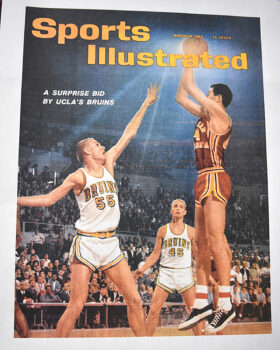
Photo submitted
Playing for Wooden, one of the most respected coaches in sports, was playing for a gentleman of the first order. Green said he never heard any profanity. If coach said, “Good gracious, sakes alive, John!” Green knew he was in trouble. Years later after graduation, if someone discovered he had played basketball at UCLA, the first thing they would ask was something about Coach Wooden.
At UCLA, the extroverted Green was nicknamed “the Mouth,” by his teammates. The 6-foot-3 standout earned Second Team All-Conference honors during each of his first two seasons before being a unanimous First Team selection as a senior. In his first season with the Bruins, he led the team in scoring with 10.2 points per game. As a junior, he ranked fourth while averaging 12.5 points and as a senior, was again the team leader with a 19.3 point average.
His 559 points as a senior ranked second in UCLA history; he graduated ranked No. 4 in school history with 1,148 career points. It was 27 years before there was a 3-point basket in college basketball.
The extraordinary season of 1961-62 began far worse than ordinary with the Bruins dropping seven of their first 11 games. But back they came to win the conference championship with a 10-2 league record. They clinched the crown at Washington after rallying back from a 12-point deficit during the final 12 minutes. Green scored the game-winner with a driving layup.
A conference championship was critical. In that era, only conference champs could compete for a national championship in the NCAA Tournament. With that early season slump, UCLA entered the tournament with a 16-9 record, the worst of any qualifier. However, the Bruins reached the Final Four for the first time in school history.
Unranked all season, UCLA was edged, 72-70, in the national semi-finals by No. 2-ranked and eventual champion Cincinnati. Bearcat Tom Thacker made a deep 25-foot shot with three seconds to play. Green scored a team-high 27 points, including 19 in the second half and a pair of free throws to tie the score with 1:34 to play.
When Green was inducted into the UCLA Athletics Hall of Fame in 2001, the program included, “Green was a three-year starting guard for Coach John Wooden from 1960-62 and a consensus first team All-American and All-Conference selection his senior season as he led the Bruins to their first Final Four appearance in history … He received the 1962 Bruin Bench Award presented to the player who showed the most improvement in all-around play and mental attitude. Previously, Green was given the 1960 Irv Pohlmeyer Award as the the team’s outstanding first-year player …”
Part of his offensive proficiency was his ability to draw fouls and get to the free throw line. In 1962, his 262 free throw attempts were almost twice as many as the next teammate. Besides being an offensive threat, Green was also a defensive leader. He said Wooden always assigned him to guard the opponents’ best guard or forward.
Basketball Hall of Fame coach John Wooden and UCLA, would soon go on to win 10 national championships in 12 years (1964-1975), including a record seven straight, surpassing the success of any other Division I program before or since. But Wooden and his Bruins first exhibited a glimpse of glory and greatness during that sensational first Final Four season of 1962.
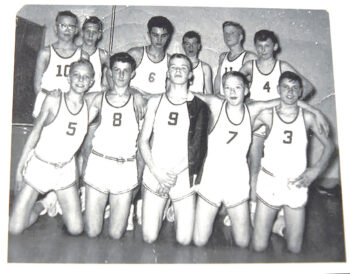
Photo submitted
Green was selected by the Los Angeles Lakers in the third round of the 1962 NBA draft. He was impressive during their rookie camp but was released after the Lakers acquired veteran guard Dick Barnett to be a backup guard. Green continued to play successfully in area adult leagues. Meanwhile, he began a long-lasting career in banking and real estate appraisal.
You can take the boy out of Houston, but you could not take Houston out of the boy. Green, treasuring memories of his boyhood home, informed his adult son and daughter that when he dies, he wants his ashes spread over athletic fields in Houston. And then after four years of retirement in California, Green moved back to Houston in 2003 and still resides there in 2026.
Jon Huhn says
Great story on a great guy! Thanks for doing this!